

PLANS to diversify a National Trust campsite on the Pembrokeshire coast, with seasonal siting for campervans and ‘landpods’ have been approved.
In an application recommended for delegated approval at the June meeting of Pembrokeshire Coast National Park’s development management committee, the National Trust sought permission for a change of use of land for camping, the seasonal siting of five ‘landpods’ and 20 campervans and associated works at Gupton Farm, near Freshwater West.
The application was before the committee rather than being decided by planning officers as it is an application recommended for approval which was a departure from the adopted Local Development Plan 2.
An officer report recommending approval said the 4.5 hectare site currently operates as an established seasonal campsite under a National Trust exemption certificate, with a permission dating back 10 years or so for five campervans and 45 tents, and a maximum of 50 pitches.
“The proposal seeks to formalise and diversify the existing operation by allowing greater flexibility in accommodation type and pitch management whilst maintaining the existing overall site capacity of a maximum of 100 people and 50 pitches per night.”

It added: “The submitted information confirms that the proposal does not seek to increase overall occupancy levels at the site but instead proposes a redistribution of accommodation types through increased campervan provision and the introduction of seasonal landpods. The landpods are proposed as free-standing seasonal structures with no permanent drainage or utility connections and would be removed from the site during December, January and February.”
It says that, while the scheme represents a departure from planning policy “due to the sensitive coastal landscape location,” officers consider “that the seasonal nature of the proposal, the established exempted camping use, the absence of any increase in overall site capacity, the landscape-led design approach and the significant biodiversity and visitor management benefits weigh in favour of the proposal”.
The report adds an original pre-application proposal conflicted in part [with policies] “due to the scale and sensitivity of the site location,” officers advising there could be scope to support “a reduced-scale, clearly seasonal proposal where robust landscape mitigation, ecological enhancement and visitor management justification could be demonstrated”.
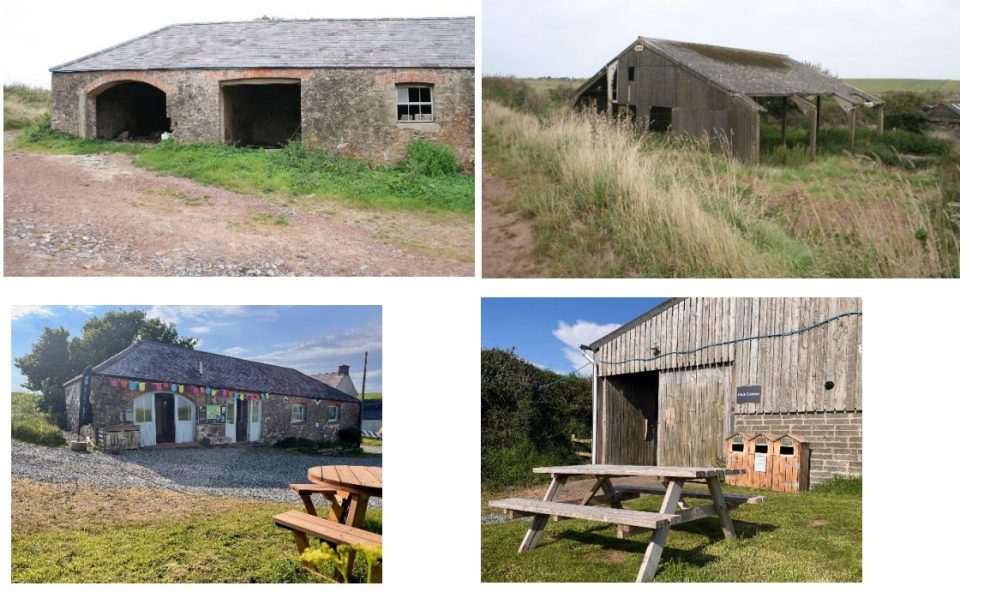
It said the submitted application sought to address those concerns; the scheme which incorporates “significant landscape and biodiversity enhancement measures” is “specifically designed as a seasonal and reversible form of development, with the Landpods removed from the site outside the operational season and stored within an existing onsite barn”.
The report later said: “On balance, it is considered that the proposal would not result in unacceptable harm to the special qualities of the National Park and that the material considerations in favour of the proposal outweigh the identified policy tensions in this instance. The principle of the development is therefore considered acceptable subject to appropriate planning conditions.”
It is recommended to delegate conditional approval to officers following the end of a public advertisement period for a policy departure.
Moving approval, Dr Madeleine Havard, chair of the authority, welcomed the seasonal nature of the proposals and the offer of more formal pitches for overnight campervans in the area.
“No overall increase [in pitch numbers] is quite important; critical for me is this is seasonal, therefore we are able to ensure the pods are able to be taken away.
“The possibility it might be able to help the situation in the area regarding campervans as well, I think it’s also very positive.”
The application was approved with 15 votes in favour and one abstention.