



CARDIFF Council has approved a massive 33-storey building in the city centre that could redefine the city’s skyline.
A 400 room co-living building, proposed by Watkin Jones Group, has received planning consent to be built in one of Cardiff’s busiest roads.
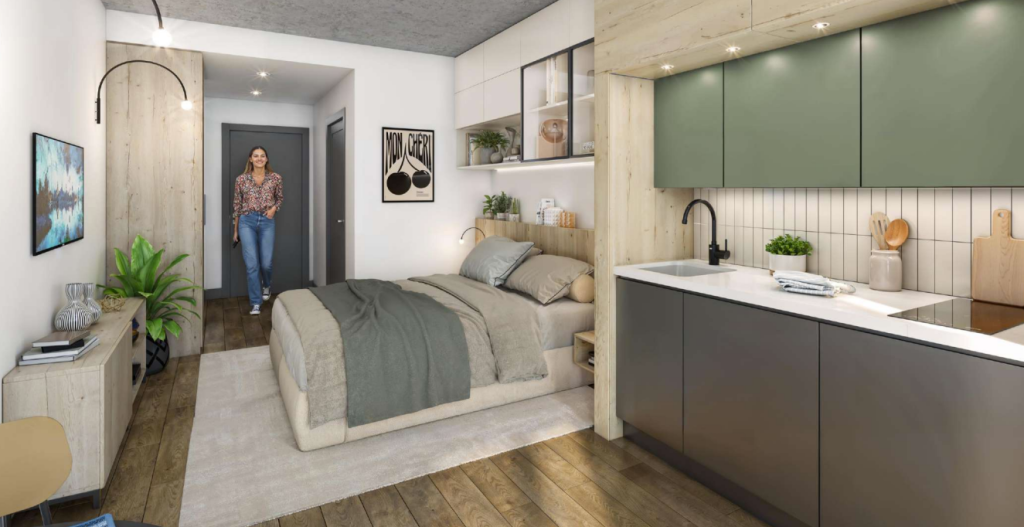
The application reads: “Co -living developments are designed to accommodate residents who share common areas, such as kitchens and living areas, while having private ensuite bedrooms.”
It continues: “The co -living concept promotes community living, fostering social interaction, collaboration, and shared resources.
“Co -living spaces are often targeted at younger professionals or transient workers and typically offer flexible lease terms, fully furnished rooms, shared amenities and a single monthly payment.”

The skyscraper is proposed to include communal kitchens, terraces and a gym.
During the meeting, councillors were impressed by the design of the building.
Cllr Adrian Robson said the development would “stand out noticeably” from other buildings in the area, where Custom House Street, Bute Street and Hope Street meet, and described it as a “deep green” colour.
Cllr Jon Shimmin said the building would “stick out very deliberately… I love that.”
Cllr Sean Driscoll added: “The design is great, I do like the building” and joked that it is an improvement on previous plans to build student accommodation on the site as the council tax revenue would be “more than welcome”.
While councillors are generally supportive of the proposed skyscraper, some criticised the plans due to lack of cycle storage space for residents, with Cllr Shimmin saying: “If we want to encourage more cycling around the city, then they need to have more secure cycle storage for a development of this size.”

Cllr Peter Wong heavily criticised the proposal on this aspect as only 241 cycle spaces are proposed.
The planning reports read: “The proposal therefore delivers approximately 60% of the required provision.”
In response to this, Cllr Wong said: “That is it doesn’t provide the required provision.”
He continued: “[The planning officers are] using our previous failure to secure minimum standards, as set out in the guidance, as a precedent for continuing to do so.”

But added that he “appreciates” that the council’s planning team “works hard” and “argues hard” to secure what cycle space they can.
Planning officer Kenneth Reid responded that, under the application’s travel plan, cycle storage use would be monitored and the amount of storage would respond to demand.
The application reads: “The design will positively contribute to the surrounding urban fabric creating a new addition to the Cardiff skyline on a key nodal site that has been unoccupied for a considerable period of time.
“The development of this site aligns with Cardiff’s regeneration goals and will provide much needed high-density residential accommodation [with] a sustainable city centre location. “