
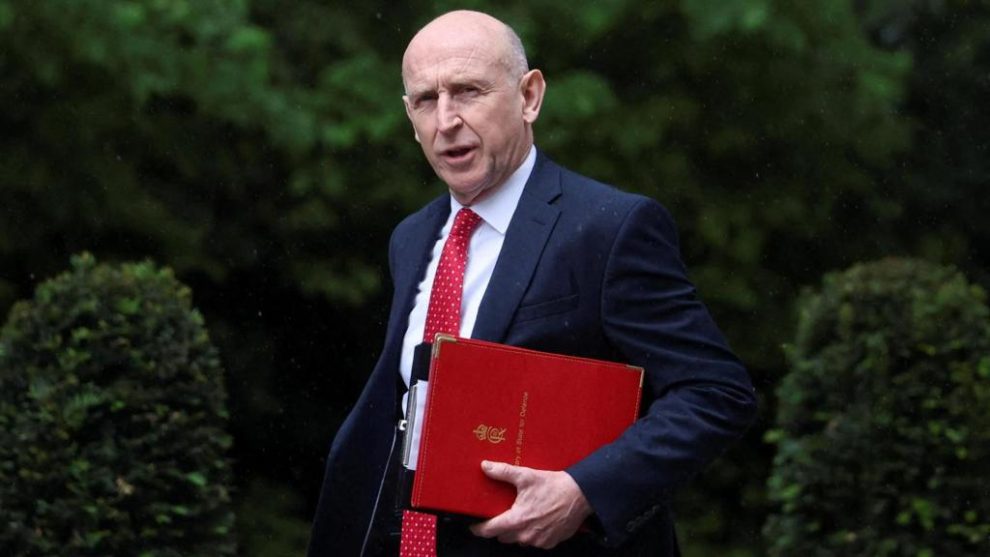

DEFENCE SECRETARY John Healey has resigned in a major blow to Sir Keir Starmer, warning that the Government’s defence spending plans risk leaving Britain less safe at a time of growing international danger.
In a sharply worded resignation letter to the Prime Minister, Mr Healey said he could no longer support the Government’s Defence Investment Plan, arguing that the financial settlement failed to provide the Armed Forces with the resources needed to meet the threats facing the UK.
His departure is one of the most serious resignations of Sir Keir’s premiership and comes ahead of the expected publication of the long-delayed defence plan, which is intended to set out how Britain will rebuild military capability, improve readiness and respond to growing threats from Russia, instability in the Middle East, and wider global insecurity.
The row centres on the pace and scale of defence spending. Sir Keir has pledged to increase defence spending to 2.5% of GDP by 2027 and 3% by 2034, but Mr Healey had pushed for a faster rise, arguing that the pressure on the Armed Forces is immediate and cannot be pushed into the next decade.
The former Defence Secretary is understood to have wanted a stronger commitment to reach 3% by 2030, amid warnings that the Army, Navy and RAF face major gaps in equipment, personnel and readiness.

In his letter, Mr Healey criticised both Number 10 and the Treasury, saying the Prime Minister had been unable, and the Treasury unwilling, to provide the funding needed. He warned that the proposed settlement would force unacceptable choices, including risks to operational readiness and the safety of service personnel.
A resignation with real force
Cabinet resignations are not unusual in Westminster, but this one is different.
Mr Healey was not regarded as a loose cannon or serial rebel. He was seen as a loyal, experienced and serious figure, closely associated with Labour’s attempt to present itself as a responsible party of government on defence and national security.
That is why his resignation is so damaging.
He is not leaving over a personal scandal, a reshuffle grievance, or a minor policy disagreement. He is leaving while accusing the Government of failing to fund the defence of the country properly.
For any Prime Minister, that is a dangerous charge. For Sir Keir Starmer, who has repeatedly sought to present Labour as strong on national security, it is politically explosive.
The timing is also significant. Britain is preparing for a NATO summit next month, Ukraine remains at war with Russia, tensions in the Middle East remain high, and European countries are under growing pressure to take more responsibility for their own defence as US priorities shift.
Mr Healey’s resignation turns what had been a technical dispute between departments into a full political crisis.
The Treasury problem
At the heart of the row is a familiar Whitehall battle: the Ministry of Defence says the threats are growing and the money must follow; the Treasury says the public finances are already under severe pressure.
Rachel Reeves faces demands from every direction. The NHS, schools, local government, welfare, transport and energy all want more money. Defence is now making the same argument, but with one added warning: delay could have consequences not only for public services, but for national security.

That makes the politics difficult. Spending more on defence means either higher taxes, more borrowing, or cuts elsewhere.
But Mr Healey’s argument is that Britain no longer has the luxury of treating defence as something that can be fixed later. His central message is that the threat is now, but the money is being pushed too far into the future.
That “backloading” of funds is likely to become one of the key phrases in the argument. In simple terms, it means promising more money later while leaving the Armed Forces short in the immediate years ahead.
Why the military will be watching closely
The resignation also raises deeper questions about military confidence in the Government’s plans.
Reports that senior military figures have raised concerns about the funding settlement will add to the pressure on Downing Street. If service chiefs believe the money does not match the commitments being made, the issue becomes more than a political row. It becomes a question of whether ministers are asking the Armed Forces to do more than they are properly equipped to deliver.
The UK already has major defence pressures. The Army has shrunk significantly over recent decades. The Royal Navy faces demands across the Atlantic, the High North, the Gulf and Indo-Pacific. The RAF must maintain air defence, support NATO and contribute to operations overseas. Meanwhile, stockpiles, drones, air defence systems, cyber capability and industrial production have all become more urgent because of the war in Ukraine.
Ukraine has shown that modern war burns through equipment, ammunition and technology at a frightening rate. It has also shown that countries which enter a crisis with hollowed-out forces quickly discover that rebuilding military strength cannot be done overnight.
That is the deeper warning behind Mr Healey’s resignation.
Political reaction
The Conservatives are expected to seize on the resignation as proof that Labour cannot be trusted on defence. They will argue that if the Defence Secretary himself believes the Government is underfunding the military, the Prime Minister has a serious credibility problem.
Reform UK is also likely to attack Sir Keir from the right, claiming the Government is failing to protect the country while spending money on other priorities.
The Liberal Democrats may press for clarity on whether the Government’s commitments to NATO, Ukraine and UK defence can still be met.
Within Labour, the reaction may be more complicated. Some MPs will sympathise with Mr Healey’s warning, particularly those concerned about Russia and NATO. Others will worry that increasing defence spending faster could mean less money for public services and social programmes.
That internal tension could become difficult for Sir Keir. Labour came to power promising stability, competence and discipline. A Defence Secretary resigning over national security funding cuts directly against that image.
What Downing Street will say
The Prime Minister is likely to insist that the Government remains committed to the strongest possible defence of the UK and to meeting its spending targets.
Downing Street will argue that defence spending is rising, that the Government has already made major commitments, and that any plan must be financially credible.
It will also stress continued support for Ukraine and Britain’s role in NATO.
But that may not be enough to kill the story.
The problem for Sir Keir is that Mr Healey’s resignation letter gives the opposition a simple line of attack: if the Government’s own Defence Secretary says the plan is not good enough, why should the public believe it is?
What happens next
Sir Keir will now need to appoint a new Defence Secretary quickly. The replacement will face an immediate and difficult task: defend a Defence Investment Plan that helped drive out their predecessor.
That is not an easy starting point.
The new minister will have to reassure the Armed Forces, the defence industry, NATO allies and MPs that Britain’s defence plans remain credible.
They will also have to answer a blunt question: has the Government matched its military promises with the money required to deliver them?
This resignation will not disappear quickly. It goes to the centre of one of the biggest questions facing the UK: whether the country is prepared for the world it now lives in, rather than the safer world it wishes still existed.
For Sir Keir Starmer, the danger is clear. A Prime Minister can survive many rows over spending. But when a Defence Secretary resigns saying the country is being left less safe, the argument becomes far more serious.