

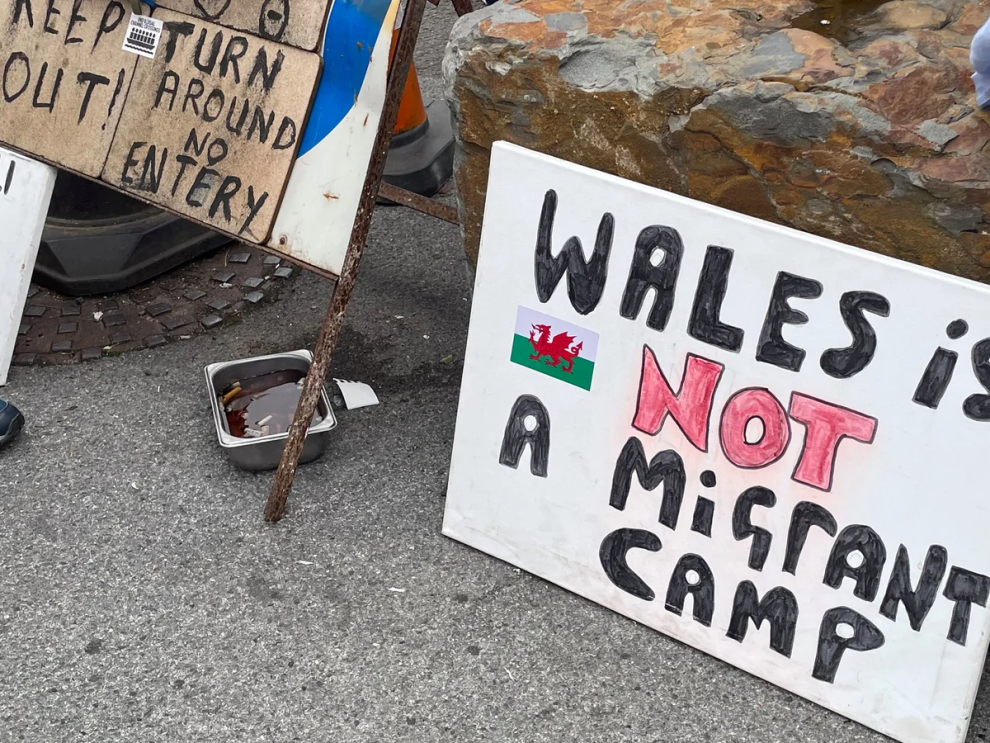

Tensions in communities across Wales have reached what one Senedd committee has described as “a level of toxicity”, with warnings that without swift intervention, the country could face “widespread civil unrest”.
Incidents ranging from a Chinese woman being pushed from her bike, social care workers being told to “go home”, and Black schoolchildren being verbally abused on a school trip have been cited as alarming examples of rising hostility towards refugees and asylum seekers.
The findings come from a cross-party Senedd inquiry into social cohesion, which heard evidence from community leaders, experts, and frontline workers. Many expressed fear not only for their own safety but also for the welfare of those they serve.
Committee members warned of “a tinderbox of discontent” that, if left unchecked, could see “whole communities go up in flames”.
“We heard worrying evidence which suggests tensions are rising; left unchecked these could lead to widespread civil unrest,” the report concluded.
Rising hostility and far-right influence
The Welsh Refugee Council (WRC), which operates offices in Cardiff, Newport, Swansea and Wrexham, told the committee that discriminatory and anti-migrant sentiments, though not new, have “been on the rise recently”.

“In Wales alone there have been four separate incidents affecting social cohesion in the last three years,” the organisation said, referring to protests in Llantwit Major over housing Ukrainian refugees, the Stradey Park Hotel protests in Llanelli during spring and summer 2023, the August 2024 riots, and online attacks against the charity in late 2023 and early 2025.
While the riots that shook parts of England in 2024 did not spread to Wales, the WRC noted that they were marked by “racist, Islamophobic, and anti-migrant sentiment”, which had a chilling effect across Welsh communities.
The Safer Communities Network also reported that although Wales did not experience the same level of hate incidents seen elsewhere in the UK after the tragic Southport attacks, the impact was still deeply felt.
“Many community members across Wales have reported incidents of discrimination and noted feeling the need to justify their sense of belonging within their education setting, workplace, or just as part of their community,” the network said.
A survey by the WRC revealed that 56% of its staff felt less safe in Wales over the past year.
A crisis of trust
In a stark foreword to the report, committee chair Jenny Rathbone MS warned that a “crisis of trust” in politics—driven by the cost of living crisis and diminishing public resources—was “adding fuel to a tinderbox of discontent which threatens to undermine our democracy”.
“Flags were traditionally used to unite people in a common cause; now they have become interpreted as symbols of division, intimidation and threats of violence,” she wrote.
Rathbone called for stronger leadership from governments at every level to counter misinformation and the far right’s attempts to “offer simplistic solutions to complex problems”, which she said were leaving frontline workers fearing for their safety.
Despite the bleak outlook, the committee highlighted examples of resilience, including the positive response in Llantwit Major, where local groups such as the football club and church successfully countered far-right protests through “good local leadership” and a show of solidarity.
The role of the Home Office
Experts told the committee that poor communication and lack of local engagement by the Home Office had fuelled many of the problems.
The decision to house asylum seekers at the Stradey Park Hotel in Llanelli, for example, was made with “minimal notice”, leaving the local authority and residents unprepared. The far right capitalised on the situation, escalating tensions that have since spread beyond migration issues to target NHS staff from India, women, the trans community, and environmental campaigners.
The WRC argued that the Home Office “shoulders much of the blame” for undermining social cohesion.

“Its policy of giving minimal notice leaves no time for communities to adjust or prepare, fostering division instead of integration. Not only does it fail to support social cohesion – it actively undermines it,” the report said.
Poverty and policy failures
Experts pointed to poverty, inequality, and lack of access to services as key factors behind growing community tensions. Rural isolation, poor public transport, and limited housing have compounded the problem, making it harder for refugees and asylum seekers to integrate.
They also warned that disenfranchised communities were being targeted by the far right’s “rhetoric of mistrust, racism and hate”, exploiting a wider sense that “democracy isn’t delivering for ordinary people”.
Calls for long-term action
The committee heard repeated calls for sustainable, long-term funding for community cohesion projects, better housing provision, and early engagement with residents when asylum seekers are to be placed locally.
“When decisions are taken to house asylum seekers there is a need for early community engagement so communities do not feel decisions are made without them,”.
It also recommended that the Welsh Government establish an expert group on social cohesion, review funding models, and take steps to protect community spaces.
The WRC acknowledged the Welsh Government’s efforts but said more was needed:
“While the Welsh Government has taken significant steps to support community groups, more must be done to provide sustainable funding, strengthen partnerships, and advocate for policy changes at the UK level.”
As Rathbone concluded, “We must act now to prevent whole communities going up in flames.”