
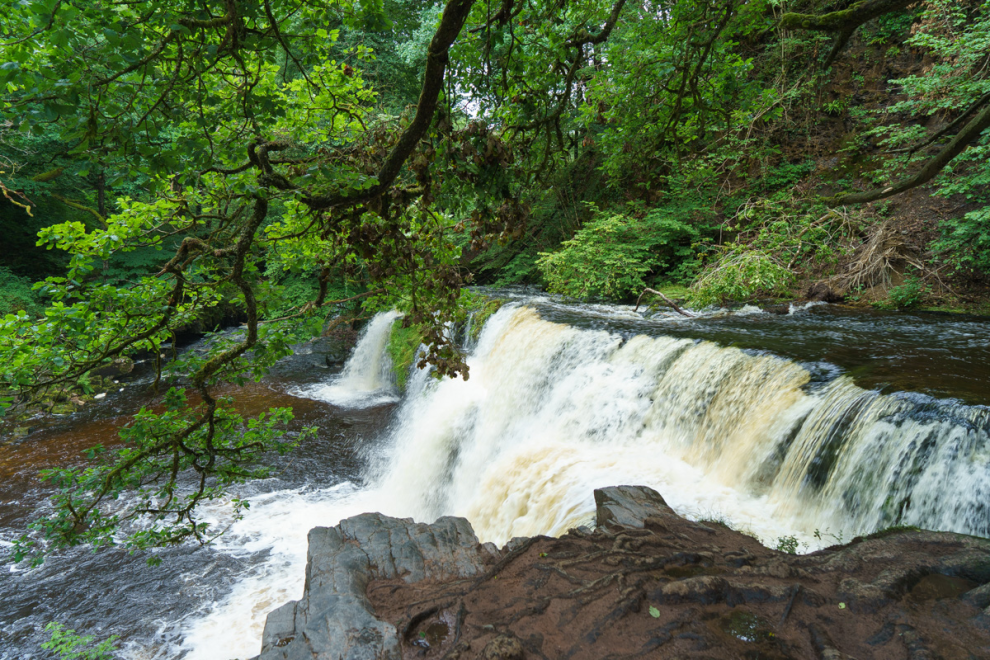
Clearer signage is needed along a popular waterfalls walking route where three people have died, a coroner has said.
Helen and Rachael Patching, aged 52 and 33, from Kent, died in January 2023, while 26-year-old Corey Longdon, from Gloucester, died in June 2024 during visits to Waterfall Country in Bannau Brycheiniog, also known as the Brecon Beacons.
Assistant coroner for south Wales central Rachel Knight said she would issue a prevention of future deaths report, calling for improved mobile phone signal in the area and clearer information for walkers.
She said it was “unusual” to hold three inquests together, but explained that the circumstances were sufficiently similar, given the location and the events leading up to each death.
At a hearing on Thursday, the court heard that Helen and Rachael Patching, from West Malling in Kent, were “happiest when walking up mountains” and shared a deep love of the outdoors. They were also passionate about animals, volunteering and fundraising for animal charities.
Married in 2015, the couple were described by their families as a “perfect match”, whose deaths had left a “deep and lasting impact”.
Helen Patching, who worked for the probation service, was found at Sgwd y Pannwr on 5 January 2023, a day after the pair were reported missing. Rachael Patching, who was training to become an animal behaviourist, was found three days later in the River Neath near the Spring Lake camping site in Glynneath.
The search began after members of the public spotted what they believed was a body in the waterfall, although the inquest heard that “no witnesses saw Rachael or Helen enter the water”.
Their families told the court they did not believe either woman would have entered the water voluntarily, noting they appeared to still be wearing full clothing when seen. They were described as “experienced walkers”.
It was thought likely that one of the women fell into the water, with the other attempting a rescue.
Corey Longdon, a holiday park entertainer, had visited the area with his aunt, Lisa Lane, and camped overnight before setting out on a walk near Sgwd Isaf Clun-Gwyn on 26 June 2024.
His family said he was “the happiest he had ever been” ahead of the trip and that he loved music and performing.
Ms Lane told the inquest that during the walk her nephew had gone ahead to find a shortcut. Some time later, she heard “a very loud splash and someone screaming for help”.
Another witness said they heard “the sound of something breaking” before seeing a man fall down the mountainside and into the water from the top of a cliff around 100ft (30m) high at a spot known as Precipice Walk.
Mr Longdon was airlifted to hospital but suffered a cardiac arrest and was pronounced dead later that day at the University Hospital of Wales in Cardiff.

Recording conclusions of accidental death in all three cases, Ms Knight said it was unclear exactly how Helen or Rachael Patching entered the water, but that “it was more likely than not that one of the ladies entered the water accidentally and the other took off her rucksack to attempt a rescue”. Their cause of death was given as drowning.
Mr Longdon’s cause of death was recorded as hypoxic ischaemic encephalopathy brain injury, traumatic cardiac arrest and a fall from height.
Ms Knight said she would issue a further prevention of future deaths report after “new issues had emerged”.
“The phone signal is poor to non-existent, and a solution should be considered,” she said. “I am also concerned that paths are not sufficiently or clearly explained, and I am of the view that better and more frequently placed explanations are needed.”
The court heard that Waterfall Country attracts around 250,000 walkers a year, with many following the popular Four Waterfalls Walk — a three-hour, 9km (5.6-mile) route taking in Sgwd yr Eira, Sgwd Uchaf Clun-Gwyn, Sgwd Isaf Clun-Gwyn and Sgwd y Pannwr.
Land ownership and management were described as “a complex picture”, involving the Bannau Brycheiniog National Park Authority, Natural Resources Wales (NRW) and three local authorities.
Catherine Mealing-Jones, chief executive of the national park authority, said the organisation “holds our breath, literally every day, hoping people will be safe”.
She said one route, known as path 86, had been permanently closed following previous accidents, and that more staff had been deployed at entry points across the vast park to warn visitors of the risks.
The court also heard that the family of a man who drowned in September 2023 while trying to save relatives had offered to fund life-saving rings at each of the falls, but the authority declined the offer.
Ms Mealing-Jones said such an intervention “would more likely lead to injury” and could be seen as implying that swimming was permitted.
Following that death, the same coroner issued a prevention of future deaths report urging improvements to signage at the site.
Ms Mealing-Jones said a joint safety advisory group, involving the national park authority and NRW, met regularly to discuss site safety and management.
Andrew Lamb, a guided walk leader with decades of experience on the trails, told the inquest that he had sometimes encountered around 200 people at a single waterfall, “with 50 people in their swimming costumes”.
He said there needed to be greater focus on “how this area is really used, rather than how planners want people to use this area”.
Describing conditions at Sgwd Isaf Clun-Gwyn as often “chaos”, he added that the closure of path 86 had not helped.
“It needs to be a circular route and signs all the way,” he said.
Sam Jones, representing NRW, said there had been significant investment since the deaths, including the creation of a new route and the installation of fencing.