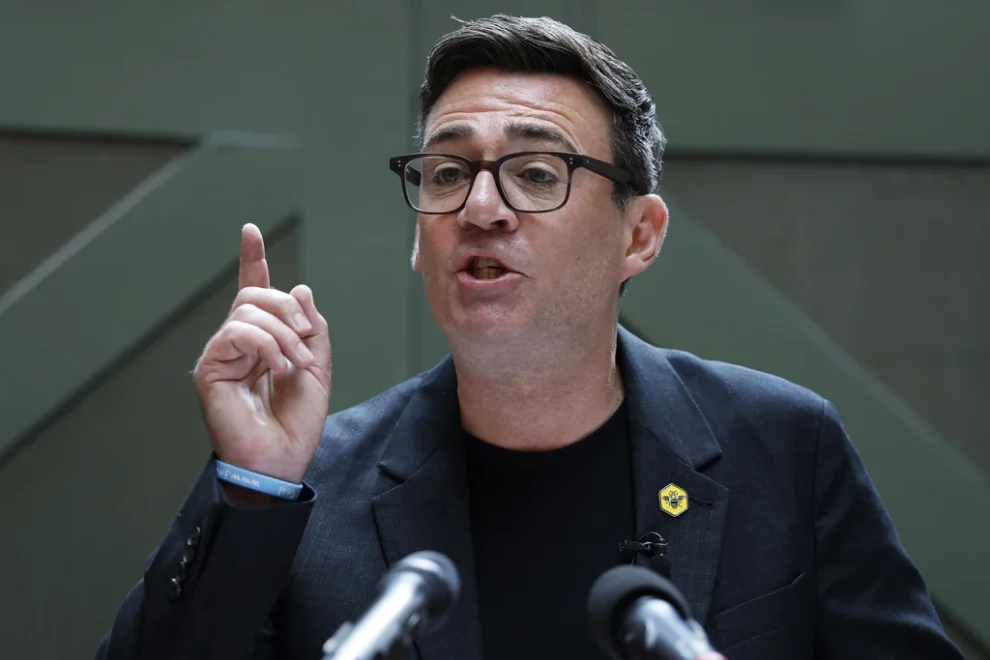

Former Greater Manchester mayor promises an ‘unashamedly Labour’ government after completing extraordinary return to Westminster
ANDY BURNHAM has been formally confirmed as leader of the Labour Party, clearing the way for him to become Prime Minister on Monday.
The former Mayor of Greater Manchester succeeded Sir Keir Starmer at a special Labour conference in London on Friday (July 17), after becoming the only candidate to secure enough nominations to enter the leadership contest.
Burnham received the backing of 379 of Labour’s 403 MPs, bringing the contest to an end without a ballot of party members.
Sir Keir will remain Prime Minister over the weekend. He is expected to visit Buckingham Palace on Monday (July 20) to formally tender his resignation to the King.
Burnham will then be invited to form a government before entering Downing Street, addressing the country and appointing his first Cabinet.
His arrival in No 10 will make him Britain’s seventh Prime Minister since 2016, following David Cameron, Theresa May, Boris Johnson, Liz Truss, Rishi Sunak and Sir Keir.
It will also complete one of the most remarkable political comebacks of modern times.
‘Unashamedly Labour’
In his first speech as party leader, Burnham promised a government with the courage to address problems which he said had been neglected by successive administrations.
He said Britain needed more than a change of leadership and pledged to transform the way the country is governed.
Burnham described his programme as “unashamedly Labour”, placing economic renewal, regional equality, public services and social care at the heart of his emerging agenda.
He argued that Britain had taken a series of wrong turns during the 1980s, when political power became increasingly concentrated in Westminster while industries and essential services were transferred into private ownership.
His government, he suggested, would seek to reverse that imbalance by giving communities greater control over decisions and allowing more parts of the country to take public control of services such as transport.
Burnham is expected to use his experience in Greater Manchester as a model for wider reform.
His flagship Bee Network brought buses under public control, introduced capped fares and sought to connect bus and tram services across the city region.
Supporters believe the project demonstrates that devolved government can deliver visible improvements to everyday services. Critics will question whether the Greater Manchester model can be expanded across a country facing severe financial pressures.

From regional mayor to Prime Minister
Burnham’s rise to the Labour leadership follows a decade-long political journey which appeared, at one stage, to have taken him permanently away from Westminster.
He served as an MP between 2001 and 2017 and held senior positions in the governments of Tony Blair and Gordon Brown, including Health Secretary and Culture Secretary.
He stood for the Labour leadership in 2010 and again in 2015, losing first to Ed Miliband and then to Jeremy Corbyn.
In 2017, Burnham left Parliament to become the first directly elected Mayor of Greater Manchester.
The move allowed him to build a political identity outside Westminster and to present himself as an advocate for regions which felt ignored by central government.
His national profile grew significantly during the Covid pandemic, when he publicly challenged Boris Johnson’s government over financial support for Greater Manchester during the imposition of regional restrictions.
The confrontation earned him the unofficial title “King of the North” and helped establish him as one of Labour’s most recognisable figures.
His return to Westminster was far from straightforward.
Burnham was prevented by Labour’s ruling National Executive Committee from seeking selection in the Gorton and Denton by-election earlier this year.
Following Labour’s disastrous local election results and growing pressure on Sir Keir, he was later selected to fight the Makerfield by-election.
He won the seat on June 18 with a majority of 9,231, giving him the parliamentary platform needed to contest the Labour leadership.
Sir Keir initially vowed to fight any challenge but announced his resignation days later as support within the parliamentary party collapsed.
Potential leadership rivals declined to stand as Labour MPs rapidly consolidated behind Burnham.
Less than a month after returning to the Commons, the former regional mayor is now preparing to become Prime Minister.
Immediate economic test
The celebrations are unlikely to last long.
Burnham will inherit a sluggish economy, continuing pressure on household finances, strained public services and deep concern about the state of the public finances.
His first major task will be to reassure voters and financial markets that his promise of significant economic change will not come at the cost of fiscal stability.
Attention will focus immediately on his choice of Chancellor, along with whether he retains senior figures from Sir Keir’s government or uses the reshuffle to signal a decisive political break.
Burnham must balance demands from Labour members for greater public investment with Treasury warnings about borrowing, debt interest and the limited room available for expensive new commitments.
He must also decide how far he is prepared to depart from the manifesto on which Labour won the 2024 general election.
A significant shift could help Burnham establish his own political identity, but it would strengthen demands from opposition parties for an early general election.
Another Prime Minister without an election
Burnham will become Prime Minister without having led Labour into a general election.
The transfer is permitted under Britain’s parliamentary system. A governing party can change its leader during a Parliament, with the monarch inviting the person most likely to command a majority in the House of Commons to form a government.
Labour retains a large Commons majority and the next general election does not legally have to take place until 2029.
However, opposition parties are expected to argue that Burnham should seek a personal mandate from the electorate, particularly if he intends to take the Government in a substantially different direction.
Burnham is likely to resist immediate calls for an election, insisting that Labour was elected to govern and must now deliver the change promised to voters.
Whether he eventually chooses to call an early contest may depend on his polling, the condition of the economy and his success in rebuilding support lost to Reform UK, the Conservatives, the Liberal Democrats, Plaid Cymru and the Greens.
The challenge from Reform
Reconnecting Labour with working-class voters who have moved towards Reform UK will be one of Burnham’s most urgent political challenges.
Labour’s heavy local election losses exposed anger over the cost of living, immigration, public services and a widespread belief that the Government had failed to deliver meaningful change after taking power.
Burnham’s supporters believe his less formal style and experience outside Westminster could help Labour rebuild trust in former industrial communities.
He has often presented himself as both a Labour loyalist and a critic of the Westminster system, allowing him to speak the language of political change while remaining at the head of the governing party.
But Reform will seek to portray his premiership as another internal transfer of power carried out without consulting the public.
The battle between Burnham and Reform is therefore likely to shape the next phase of British politics.
What Burnham’s leadership could mean for Wales
Burnham’s commitment to transferring power away from Westminster could have major consequences for Wales.
Welsh political leaders will be watching closely to see whether his support for devolution extends beyond English city regions and results in additional powers and funding for the Senedd.
Long-running disputes remain over rail investment, the Crown Estate, policing, justice, borrowing powers and the distribution of UK research funding.
Plaid Cymru is likely to increase pressure for further responsibilities to be transferred to Wales, while Welsh Labour will expect a closer and more productive relationship with the new Prime Minister.
Burnham will have to recognise that devolution in Wales is not simply another version of regional government in England.
The Senedd represents a nation with its own legislature, government and political identity. Any attempt to apply a single model across the UK would risk creating an early confrontation with Cardiff Bay.
His handling of Welsh funding and constitutional questions will provide an immediate test of whether his promise to move power out of Whitehall represents a genuine change in government or merely a change in tone.
A decisive moment
Burnham enters the Labour leadership with overwhelming support from his MPs, but without having faced a public leadership contest or a general election.
That has allowed Labour to complete the transition quickly, avoiding weeks of internal division.
It also means the public has heard relatively little detail about what a Burnham government will do.
His first Cabinet, his approach to the economy and his relationship with the devolved nations will begin to answer those questions.
For Burnham, Friday marked the completion of an extraordinary journey from defeated leadership candidate to regional mayor, returning MP and leader of the Labour Party.
On Monday, the campaign to reach Downing Street will be over.
The much harder task of governing Britain will begin.