

Reform UK leader joins Dan Thomas at Keir Hardie statue in Aberdare as Senedd election battle enters dangerous new territory
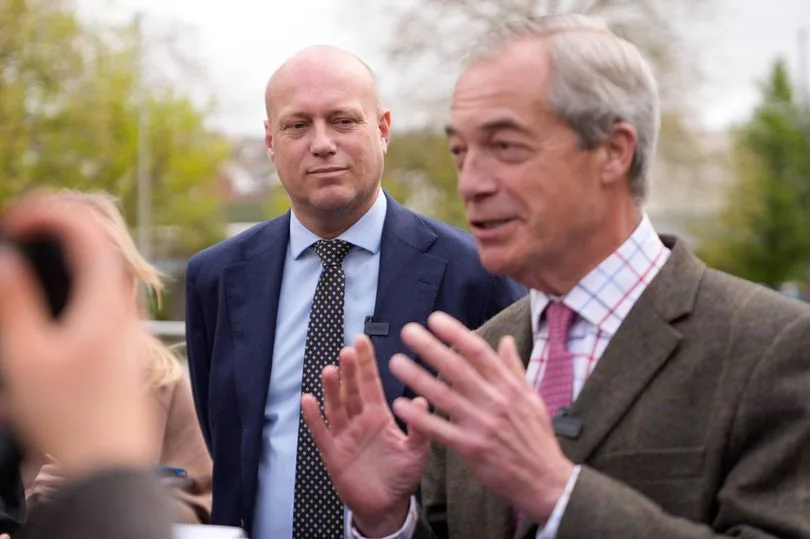
NIGEL Farage took his campaign to the spiritual home of Welsh Labour on Thursday (Apr 16), making a highly charged visit to the Keir Hardie statue in Aberdare alongside Reform UK’s Wales leader Dan Thomas.
The appearance was no routine photocall. Set against one of the most powerful symbols in Welsh political history, it was a direct challenge to Labour’s grip on the valleys and a clear sign that Reform believes the political ground beneath Wales is shifting fast ahead of the Senedd election on May 7.
Aberdare was a deliberate choice. For generations, the South Wales Valleys were the beating heart of the Labour movement, shaped by coal, steel and working-class solidarity. Keir Hardie’s name remains bound up with that legacy. By standing beneath his statue, Farage was sending a blunt message: that Reform now sees itself as the vehicle for voters who feel abandoned by decades of Labour rule in Cardiff Bay and Westminster.
Farage, accompanied by Thomas, used the stop to reinforce Reform’s central argument that Labour has lost touch with its traditional base. The visit came at a time of mounting pressure on Labour in Wales, with recent polling suggesting the party faces one of its most serious electoral threats since devolution began.
Reform has been working hard to turn that dissatisfaction into momentum. Farage has made repeated visits to Wales in recent months, while the party has sought to tap into public anger over NHS waiting times, economic stagnation, immigration, and unpopular policy decisions such as the 20mph speed limit. The party has also framed the coming Senedd election as a wider verdict on the UK Labour government under Keir Starmer.
That message was written all over Thursday’s visit.
In political terms, the Keir Hardie statue provided a perfect backdrop. In campaign terms, it was classic Farage — part symbolism, part provocation, part media moment. He and Thomas posed for photographs, spoke with people locally, and used the setting to underline Reform’s claim that Wales is no longer safe territory for Labour.
Thomas, the party’s newly appointed Wales leader, has been presented as the man who can front Reform’s push west of Offa’s Dyke. Though critics have questioned his credentials and accused the party of stage-managing its Welsh image, Reform believes the combination of Farage’s profile and Thomas’s local roots gives it a real chance of breaking through.
The wider electoral picture gives that argument added force. This will be the first Senedd election fought under the new 96-member system, which is designed to be more proportional and could make it easier for smaller or insurgent parties to win a substantial foothold. That has raised the prospect of a far more fractured Senedd, with post-election deal-making likely to become central to who governs Wales.
For Reform, that means it does not necessarily need to finish first to make history. A strong showing could be enough to shatter old assumptions, redraw political alliances, and leave Labour facing the kind of challenge it has rarely had to confront in its Welsh strongholds.
But the road ahead is far from simple. Labour still has deep roots in valley communities, while Plaid Cymru remains a serious force in a contest that is becoming increasingly volatile. Some voters may be drawn to Reform’s hard-edged anti-establishment message. Others may see it as heavy on grievance and light on answers for devolved Welsh issues such as health, housing and transport.
That tension sits at the heart of the campaign.
What Farage achieved in Aberdare was not a policy launch or a detailed argument about Welsh governance. It was something more visual and, perhaps, more potent. He chose one of the most emotionally loaded sites in Welsh political life and used it to suggest that the old loyalties which once defined the valleys are beginning to break apart.
With three weeks to go until polling day, the visit was a reminder that Reform is not treating Wales as an afterthought. Farage’s appearance in South Wales was a calculated act of political theatre, aimed squarely at Labour’s heartland and timed to maximum effect.
In the shadow of Keir Hardie, Reform UK made its boldest claim yet — that the party of protest now believes it can become a party of power in Wales.