

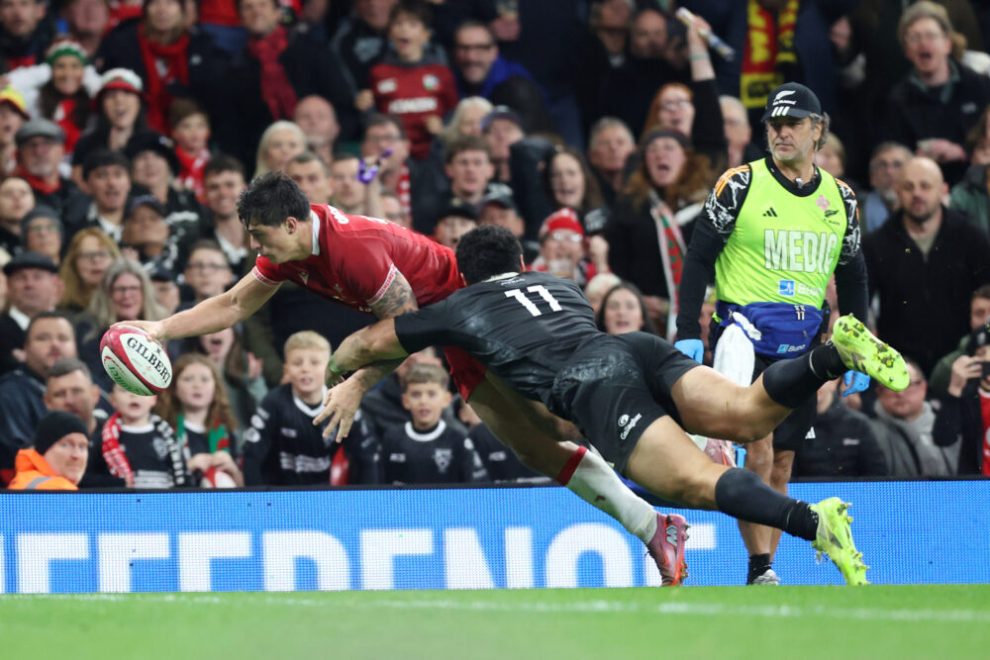

Wales 26, New Zealand 52
WALES fell to yet another heavy defeat against New Zealand on Saturday, but the mood inside the Principality Stadium at full time was remarkably upbeat. For all the frustrations of a 52-26 loss, this was a match that offered something rare against the All Blacks: genuine hope.
It was Wales’ 34th consecutive defeat in the fixture stretching back to 1953, and the third autumn in a row that New Zealand have scored more than fifty points in Cardiff. Yet for the first time in years, Wales caused the tourists real problems with ball in hand, scoring four tries and recording their highest ever points tally at home to the All Blacks.
The standout moment belonged to winger Tom Rogers, who became the first Wales player in history to score a hat-trick against New Zealand. Not since South Africa’s Marius Joubert in 2004 has any player from any nation produced three tries against the All Blacks. The Scarlets man was outstanding, finishing with precision and confidence in a performance that will define his early Test career.
Wales’ 26 points also surpassed their previous best home scores in 2004 and 2010, when they posted 25. Across 38 matches, Wales have averaged just one try per game against the New Zealanders. On Saturday they produced four.
The match began with Wales falling behind early, but the response was sharp. For the first time this autumn, they consistently won aerial contests, using those turnovers to launch quick, layered attacks. The first try came when Louis Rees-Zammit beat Damian McKenzie in the air, leading to a sweeping movement that saw Alex Mann, Blair Murray, Max Llewellyn and Dan Edwards all link before Rogers picked up a dipping offload to score.

Rogers’ second came from a smart lineout move, with Taine Plumtree carrying hard off a long throw and Dafydd Jenkins punching into the New Zealand defence. With penalty advantage in hand, Tomos Williams’ grubber was won by full-back Murray, drawing Will Jordan off his wing. Wales moved the ball wide and Rogers finished.
Two minutes into the second half, Rogers completed his hat-trick. Jenkins charged down a kick, Plumtree competed superbly in the air, and Joe Hawkins’ long pass released Llewellyn, who held his run just long enough before sending Rogers away to step inside the last defender. For a brief moment, at 24-21, the stadium believed in something extraordinary.
The All Blacks responded with typical ruthlessness. Twice they crossed the Welsh line only for the TMO to intervene: first a knock-on in the build-up to a Caleb Clarke finish, then Rogers denying Jordan with a desperate touch-in-goal. The belief inside the ground grew louder.
But that was as close as Wales came. Rieko Ioane finally settled the momentum with a try from McKenzie’s cross-kick, and when Gareth Thomas and Taine Plumtree were both yellow-carded in quick succession, the game slipped decisively from Wales’ reach. Down to 14, and then 13, Wales simply couldn’t contain the wave of black shirts, with Clarke and Sevu Reece adding further tries.
Even so, Wales found one last flourish. Following a series of strong carries from Dewi Lake, Freddie Thomas and Morgan Morse, Murray slipped a pass to Rees-Zammit, who dived in at the corner one-handed to claim a well-worked fourth try.
While conceding seven tries and losing the penalty count 14-4 are reminders of how far this young side must travel, supporters recognised the intent and ambition in Wales’ play. Many stayed long after the final whistle to applaud the team’s lap of thanks, and former captain Sam Warburton described himself as more optimistic than he expected to be. Dan Biggar agreed, saying the fans could leave the ground feeling there were “more positives than negatives.”
New Zealand were clinical, physical and devastating on turnover ball, as they almost always are. But Wales, unlike in recent years, fired back. They showed ambition, accuracy, and a willingness to play. In attack, at least, there is something to build on.
With world champions South Africa arriving next weekend, and Wales set to lose their 13 English-based players as the match sits outside World Rugby’s Test window, the challenge becomes even tougher. But for the first time in a long time, there is a sense that Wales are beginning to carve out a new identity.
It may not show in the scoreline. But it was there in the noise of the crowd, the energy of the young players, and the belief that flickered for an hour in Cardiff.
A drubbing, yes. But also a glimpse of something better.