

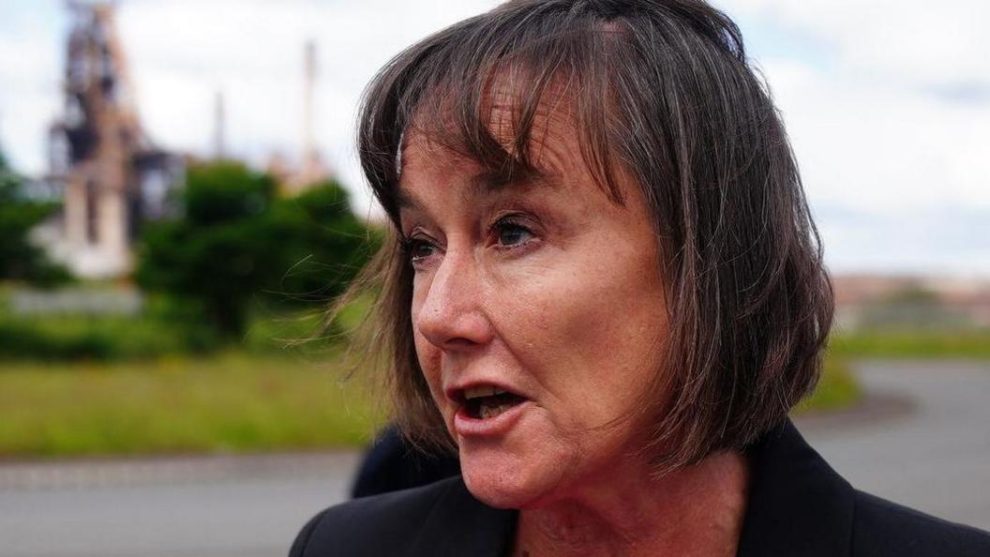

Cardiff East MP repeatedly visited Pembrokeshire to champion clean energy jobs, but her successor inherits unresolved questions over Milford Haven’s share of the Celtic Sea boom
JO STEVENS is out as Secretary of State for Wales after new Prime Minister Andy Burnham chose not to retain her in his first Cabinet.
The Cardiff East MP confirmed on Monday (Jul 20) that she would no longer serve as Welsh Secretary, bringing her two-year tenure at the Wales Office to an end.
Her departure has particular significance for Pembrokeshire, where she became one of the UK Government’s most prominent advocates for floating offshore wind, the Celtic Freeport and the transition from oil and gas towards cleaner forms of energy.
Ms Stevens made repeated visits to Milford Haven and Pembroke Dock, met apprentices and major employers and spoke directly to The Pembrokeshire Herald about the prospect of skilled jobs being created in West Wales.
Some tangible investment followed those visits. However, many of the biggest employment figures attached to the green energy transition remain forecasts rather than jobs already created.

Her successor will inherit the task of proving that Pembrokeshire will receive a substantial and lasting share of the promised economic benefits.
Departure despite backing Burnham
The decision is particularly notable because Ms Stevens publicly backed Mr Burnham during the Labour leadership contest.
She said in June that he had the experience, values and political reach required to become Prime Minister.
Her departure therefore appears to be part of Mr Burnham’s wider effort to create a new Cabinet and establish a clear break with the previous administration, rather than the result of hostility between the two politicians.
Ms Stevens is among a number of senior figures from Sir Keir Starmer’s government who have left Cabinet as Mr Burnham builds his new administration.
At the time of publication, her replacement as Secretary of State for Wales had not been announced.
Early visit to Milford Haven
Ms Stevens began building links with Pembrokeshire before Labour entered government.
As Shadow Welsh Secretary, she visited the Port of Milford Haven with Henry Tufnell in early 2024 to discuss the port’s operations, its development plans and the barriers facing further investment.
Following the visit, Labour identified ports including Milford Haven as potential beneficiaries of its proposed investment in floating offshore wind and domestic renewable-energy manufacturing.
The promise was significant for Pembrokeshire, which has lost thousands of well-paid industrial jobs following the closure of several major oil refineries.

Labour argued that investment in ports, offshore wind and associated manufacturing could create a new generation of skilled employment.
Pembroke Dock Marine opening
After Labour’s general election victory and her appointment as Welsh Secretary in July 2024, Ms Stevens returned to the county for the official opening of the £60 million Pembroke Dock Marine redevelopment.
She attended alongside then Deputy Prime Minister Angela Rayner and former First Minister Eluned Morgan.
The development included a new slipway, enlarged workboat pontoons, upgraded quayside facilities and infrastructure intended to support marine renewable-energy projects.
It was forecast that the wider development could support up to 1,800 jobs.
The project was funded and developed over several years through the Swansea Bay City Deal and other partners. It would therefore be misleading to describe it as an achievement delivered solely during Ms Stevens’ tenure.
However, she used its opening to reinforce the new UK Government’s commitment to Pembrokeshire’s energy sector and helped place the county prominently within Labour’s industrial message.
Ledwood and Dragon LNG visits
Ms Stevens returned in January 2025 to confirm Pembrokeshire’s inclusion in a clean-energy skills pilot.
During the visit, she met workers and apprentices at Ledwood Mechanical Engineering in Pembroke Dock and representatives from Dragon LNG.
The initiative was intended to help existing workers transfer their skills into sectors including offshore wind, hydrogen and other low-carbon industries.
Speaking to The Herald, Ms Stevens described the pilot as an important step towards creating the workforce required for clean-energy expansion in the Celtic Sea.
She later said she wanted more young people to be able to remain in West Wales and build careers in the emerging industries being attracted to the area.
Those visits gave the county political visibility and helped bring employers, training providers and government representatives together.
The longer-term test, however, is whether the training leads to substantial numbers of permanent jobs based in Pembrokeshire.
Investment beginning to arrive
There have been concrete developments during Ms Stevens’ time in office.
Ledwood Engineering was among the Pembrokeshire businesses selected to benefit from a £13 million offshore wind supply-chain funding programme backed by The Crown Estate.
Work has also progressed on a proposed £50 million hydrogen production facility at the former refinery site now operated as the Impala Terminal in Milford Haven.
The hydrogen scheme is expected to create around 60 jobs during construction and approximately ten permanent positions once operational.
Floating wind projects in the Celtic Sea have also moved forward through seabed leasing, government support and preparatory investment.
These developments show that the clean-energy programme is more than a political slogan.
Nevertheless, the number of permanent jobs confirmed so far remains considerably below the thousands repeatedly discussed in speeches and government announcements.
The Freeport question
Ms Stevens also strongly supported the Celtic Freeport, which links Milford Haven and Port Talbot.
The project was backed with £26 million of government funding and designed to attract investment through tax incentives, customs arrangements and simplified planning.
Ministers said the Freeport could help generate thousands of jobs and attract major private investment into South and West Wales.
However, The Herald has repeatedly raised questions about how those benefits will be divided between the two ports.
Port Talbot has secured up to £64 million to develop a specialist floating offshore wind hub and has been described as a cornerstone of the emerging industry.
Its proposed role in turbine assembly and large-scale port infrastructure has been set out in considerable detail.
Milford Haven’s role in operations, maintenance, engineering, fuel production and marine support remains important, but the eventual scale of the work and number of local jobs have been less clearly defined.
That does not mean Pembrokeshire has been excluded from the opportunity.
It does mean that the incoming Welsh Secretary must provide greater clarity about what work will be based locally, when it will begin and how many permanent jobs it will create.
Stevens defends her record
In announcing her departure, Ms Stevens said serving as Welsh Secretary had been a privilege and an honour.
She said her priorities had included attracting investment, creating jobs and giving Welsh communities greater control over their futures.
Ms Stevens highlighted what she described as the largest Welsh public-services settlement since devolution, support for the steel industry, investment in nuclear power at Wylfa and a long-term commitment to Welsh rail infrastructure.
She also pointed to local-growth funding and cooperation between the UK and Welsh governments.
Those are substantial claims and form an important part of any fair assessment of her tenure.
Critics will argue that several major commitments, particularly on rail funding and green employment, have yet to produce all the results promised.
Supporters will point out that large infrastructure and energy projects take years to develop and that many of the schemes promoted during her time in office are still at an early stage.
Pembrokeshire promises now pass to successor
Jo Stevens leaves the Wales Office having made Pembrokeshire a regular feature of the UK Government’s clean-energy narrative.
She visited the county, met local businesses and apprentices and repeatedly argued that West Wales should benefit from the transition towards floating wind, hydrogen and renewable energy.
Her record should not be dismissed simply because every promised job has not yet materialised.
Equally, announcements, visits and projected employment figures cannot be treated as completed delivery.
The fairest conclusion is that Ms Stevens helped advance Pembrokeshire’s case and supported several important projects, but leaves before the full economic outcome is known.
Her successor must now turn broad ambitions into named contracts, firm investment decisions and permanent, well-paid employment.
For Andy Burnham’s new government, the question is not only whether it will retain the promises made to Pembrokeshire.
It is whether local communities will finally see those promises translated into jobs.