
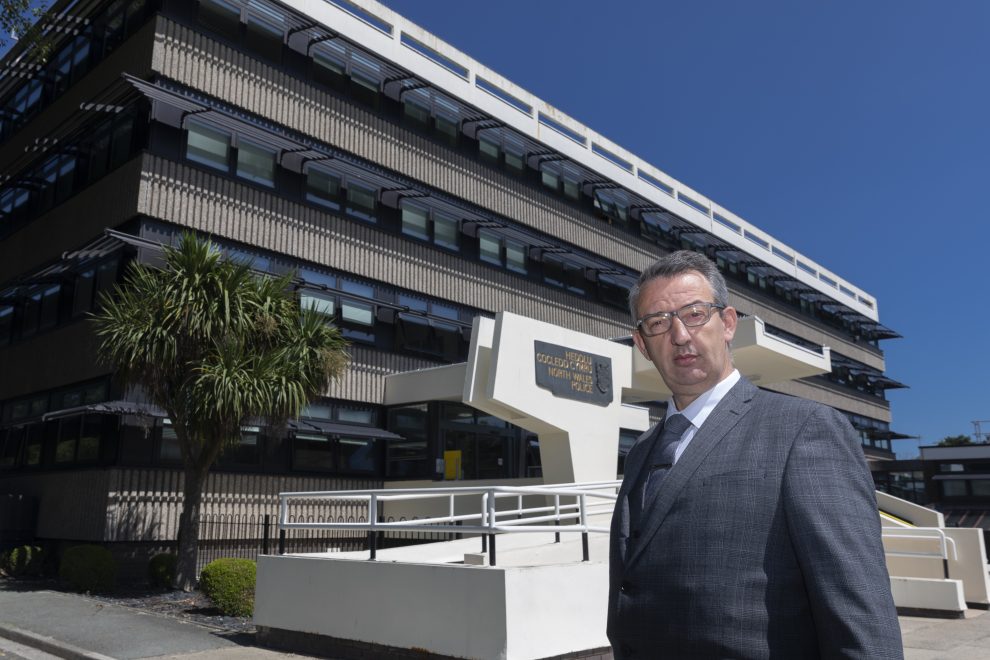

NORTH WALES Police and Crime Commissioner (PCC) Andy Dunbobbin has announced he will ask the Police and Crime Panel to approve an increase in the policing precept of 50p per week (or £26.10 per annum) for a Band D property for the financial year 2026-27.
Around half the money for the police budget in North Wales comes from the UK Government and the rest comes from Council Tax. The amount of Council Tax depends on the precept levied by the Police and Crime Commissioner. The amount that will be received from the Government to help fund policing is still to be fully clarified. However, if funding is available, it is hoped to invest in areas such as the Force Control Centre, which will help improve response times; the Digital Forensics Unit, which will help in solving crimes; and the Protecting Vulnerable People Unit, which assists some of the most at-risk members of society.
Mr Dunbobbin will make the proposal of the increase to the Police and Crime Panel at a meeting on 30 January 2026. If the Panel agrees to the increase, it will become effective in the next financial year from April 2026.
Nearly half of people who participated in a survey on the proposals were supportive of an increase in the policing precept of at least £25 per year. So, the recommended figure of £26.10 is in line the amount seen as acceptable by those who took part. The survey took place with the people of North Wales over six weeks from November 10 to December 19, involving over 1,300 responses.
To ensure broad participation, the survey was advertised widely across various social media platforms, while paper copies were distributed at libraries and police stations across North Wales and via community groups. The survey promotion also extended to public consultations and events attended by the PCC and OPCC staff, including a six-location public engagement event called the People’s Pulse, which visited Bangor, Ruthin, Flint, Wrexham, Barmouth and Colwyn Bay.

Andy Dunbobbin commented: “My decision to propose a £26.10 increase per year in the Policing Precept for an average property for 2026/7 has not been an easy one.
“I know that many people and many families are struggling with the cost of living. This is something I see and hear day-in, day-out as I visit communities across North Wales as PCC and as a local Councillor in Deeside.
“I am rooted in our community and I want the very best for it, both socially and economically. And a vital part of achieving this is through ensuring we have a well-funded and effective Police Service.
“If we have sufficient funding available, I hope to see investment in several areas that people tell me all the time they want to see improved, such as Police response via 999 and 101.
“The members of the public who took part in my survey and attended my People’s Pulse events were clear about the need to give Police the right tools to get their job done and to protect us, and I hope my proposed increase to the Precept will help in this mission.”
While the policing precept is charged as part of Council Tax bills, the precept amount goes only towards paying for policing. The rest of the Council Tax goes towards paying for fire and rescue services, as well as for the local council to provide services such as refuse collection, street lighting, education and social care.
The final decision on the increase in the precept will now be made by the North Wales Police and Crime Panel at their meeting on January 30, 2026 in Coed Pella, Colwyn Bay, which will be live streamed on Conwy County Borough Council’s website. The Police and Crime Panel is a body made up of ten councillors from across North Wales and three co-opted independent members and scrutinises the work of the Police and Crime Commissioner.
PCC Dunbobbin advises that if anyone is struggling with paying their Council tax, they should contact their local Council to see where support and help is available.