

WELSH Government should fund mandatory automated monitoring at landfill sites like Hafod to ensure public confidence in nuisance odour data.
That was one of the key findings of the Senedd Petitions Committee report released today (Thursday) into the 20 year campaign by residents of Johnstown, Rhos and Ruabon against smells coming from the former quarry site.
The committee stopped short of campaigners’ hopes that it would revoke Enovert’s permit to operate Hafod Landfill, but made a series of recommendations around more independent monitoring and transparent data reporting.
It also pledged that the report would form part of a major review of welsh landfill regulations by the Senedd carried out after this year’s upcoming elections.
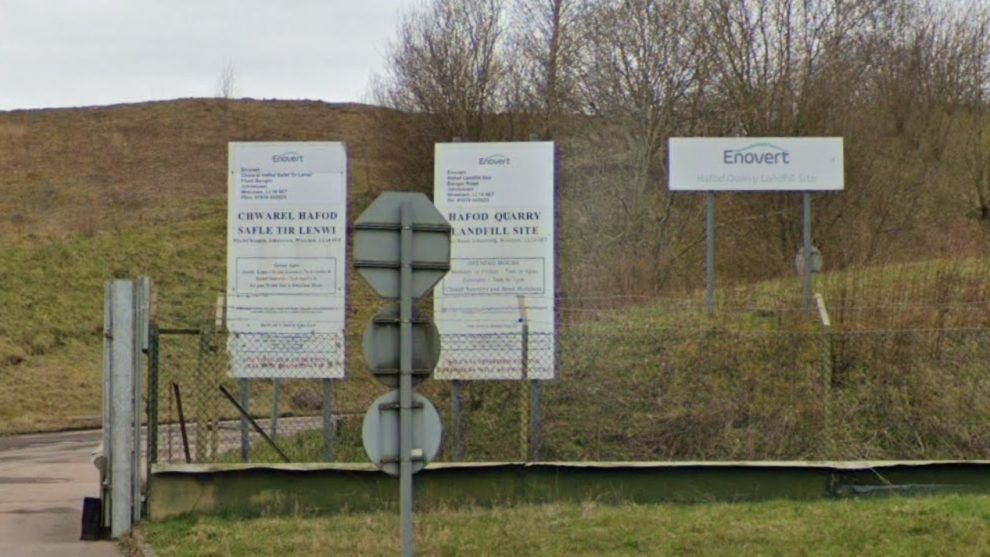
Operated by waste management firm Enovert and regulated by Natural Resources Wales (NRW) with oversight from Wrexham County Borough Council, Hafod Landfill has been subject to protests and complaints by those living nearby regarding the smells caused by hydrogen sulphide.
The gas causes a rotten egg smell that is unpleasant for those living nearby but campaigners have also claimed that it exceeds safe exposure levels for humans.
Data provided by Enovert has refuted this claim, but now the Welsh Government committee has said that more independent monitoring is needed to restore public trust.
“There is clearly a breakdown of trust between the local authority and some local residents on how the breaches at Hafod have been investigated,” found the committee.
“The fact that monitoring work has been co-funded by Enovert, and analysed by consultants it had appointed, is likely to be a factor in residents’ lack of trust in the data.
“The Welsh Government should introduce mandatory automated odour monitoring at landfill sites. This is not something currently required by NRW and Welsh Government should ensure that regulators are sufficiently funded to facilitate this.”
One of the key defences of measures taken at Hafod Landfill was falling resident complaints. The Petitions Committee found however that this was most likely due to a lack of belief that complaints were being listened to.
“Complaint fatigue is real,” it stated. “Members admire the commitment of campaigners to keep raising their concerns and calling for action.
“The committee’s scrutiny has put the voice of residents on the record. It has underscored the importance of trust and effective community relations – people need to not only feel their voices have been heard, but that they have been listened to and their concerns taken seriously.”
It also expressed shock at the continued use of ‘sniff tests’ by NRW as part of its regulation activity.
“One of the surprising things to come out of the inquiry is the reliance by NRW and local authorities on subjective sniff tests,” it said.

“If it were not for consistent community complaints and the cooperation of Enovert, there would be no technical monitoring regime at Hafod.”
The report accepted there had been a number of breaches recorded in late 2024 and early 2025 and that the nuisance continued to impact residents, but it dd not find enough evidence to suggest a danger to human health or to force the closure of the site.
In all the committee made 11 recommendations which included Enovert and Wrexham Council ensuring their monitoring equipment is fully independently calibrated and data published immediately in real-time, Welsh Government providing clear advice to the Welsh Local Government Association and local authorities across Wales on how they can protect communities from statutory nuisance and asking NRW to review its Hydrogen Sulphide thresholds and consider adding the ‘rotten egg smell’ the gas produces to its environmental permit conditions.
It also recommended a thorough investigation into the claim that the smell at Hafod is made worse by periods of rainfall and that Wrexham Council should clarify for residents in simple terms how it intervenes in the operation of the site while providing regular online updates.
Finally it recommended the council clarify the criteria for residents to participate in the Hafod Liaison Group – which is made up of councillors and residents – and published minutes from that group punctually. It also recommended three residents had a place on the Hafod Stakeholder Group – a high level monitoring group featuring representatives from Enovert, NRW and local councils.
Resident and lead petitioner Steve Gittins welcomed the report.
“Although Hafod Landfill permit has not yet been revoked, today is a massive day for our community,” he said.
“We have successfully shifted the narrative from a ‘local nuisance’ to a ‘national regulatory failure’. The report explicitly states that the ‘current permit will continue to fail communities and residents, unless it changes, not just locally, but nationally’.
“We aren’t stopping here. We will take these findings to the Seventh Senedd to lobby the new Welsh Government and ensure national landfill laws are rewritten.
“A massive thank you to the Senedd Committee for their diligence and to every member of the community around Hafod for your unwavering support.”
A spokesperson for NRW said the recommendations were being reviewed.
“We welcome the Welsh Parliament Petitions Committee report and will carefully consider the recommendations alongside the Welsh Government,” they said.
“In the meantime, we continue to regulate the Hafod Landfill site in accordance with its environmental permit, to minimise odours and protect local people and the environment.
“We understand the concern from the community. If residents need to report an environmental or pollution incident they can contact our 24/7 incident communications centre via our online report it form on our website. They can also contact us round the clock on 0300 065 3000.”
In a statement Wrexham Council said: “We have been working in partnership with the site operators, the regulator and local stakeholders, including elected representatives and residents as part of the Hafod Landfill Stakeholder and Liaison Groups to the benefit of the local community.
We have already seen progress on a number of points raised in the report including the full calibration and re-scaling of data from all six monitoring pod’s, odour acuity testing for staff deployed for sniff tests and new terms of reference and a commitment to turn around minutes quicker from Hafod Liaison Group.
“Other recommendations are in progress as we continue to engage on ways to mitigate, monitor and reduce impacts of odour emitted from the site.
“Wrexham Council has installed two community air quality monitoring units and carries out in person officer odour checks throughout the affected communities five days a week. This is to help NRW assess the level of odour nuisance and inform the public via detailed reports posted on the NRW Citizens Space.
“Hafod Landfill Stakeholder and Liaison Groups will continue their ongoing commitment to maintain collaboration and keep the public informed as we progress.
“While NRW are the key regulator, Wrexham Council will remain fully engaged to support all partners to reach a satisfactory conclusion as outlined in the council motion (to seek a review of waste management at the site, explore possible alternatives, determine the impact on local people and demand ongoing, robust reporting of emissions).”
A spokesperson for Enovert added: “We are aware of the Senedd Committee’s recommendations and will work with all stakeholders and where action is required of us to fulfil them.”