
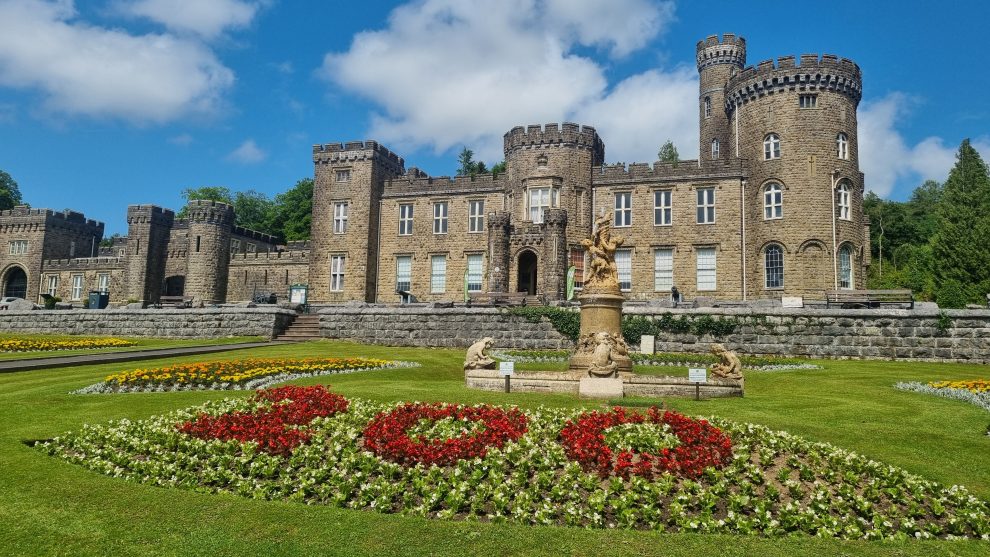

CYFARTHFA Castle is one of the jewels in the Merthyr Tydfil crown.
It stands proudly in the county borough’s gorgeous Cyfarthfa Park and is one of the Valleys’ and south Wales’ most treasured assets with an illustrious history.
But in recent times the condition of parts of the castle has deteriorated and now work is under way to try to deal with the issues.
Welsh Government – through its historic environment service Cadw – and Merthyr Tydfil County Borough Council will each contribute £2.25m to address the deterioration to the oldest part of Cyfarthfa Castle as well as protecting Pont-y-Cafnau bridge, located to the south of the wider Cyfarthfa site – reputedly the oldest iron railway bridge in the world.
A council report in February 2025 said the castle was in a “significant state of deterioration” adding the condition of the property had continued to deteriorate and was now fast approaching a state of dereliction, raising serious safety concerns and an increasing cost of rehabilitation.

Since a previous council report in July 2023 additional ceilings had collapsed and a tap-test of the ceilings had resulted in certain rooms being isolated from entry.
A condition survey identified the need to protect the building and suggested a scaffold with a roof covering be erected to prevent further water ingress and associated deterioration while giving the building the opportunity to dry out.
It was recognised a drainage solution would be required to allow for the controlled discharge of rainwater from the scaffold.
Plans have been approved to improve the drainage at the park and castle including a new below-ground level drainage network.
And from November 3 essential work began to install a brand-new underground drainage system that will run the perimeter of Cyfarthfa Castle as well as through the park and gardens.
During these works people may see footpaths and areas of the park temporarily closed off to maintain public safety.
The council says it will try to minimise the level of disruption for residents and visitors while works are in progress.
A heritage impact statement says the designing of a new drainage strategy also provided the opportunity to develop a permanent solution to existing issues with the drainage runs across the site.
Most drainage routes for the discharge of surface water within the park are historic with many undersized and judged to be in poor or defective condition as confirmed by CCTV survey.
The result of inadequate drainage is that rainwater runs off the sloping land to to the north of the castle and enters the basement.

The parkland has also suffered in recent years with trees lost as a result of waterlogged ground.
The proposed drainage strategy has been designed to allow for the discharge of water run-off from the tented scaffold.
It also aims to provide a permanent solution to the wider problem of inadequate drainage within Cyfarthfa Park.
A new below-ground surface water drainage network is being installed to take water away from the building via attenuated controlled discharge to an existing Welsh Water connection at the south-east of Cyfarthfa Park.
The project includes the installation of new drainage channels around the perimeter of the castle which will involve excavation behind the existing retaining wall to the south and east of the castle and across the south terrace.
These runs will be connected to new drainage routes running south-east away from the castle and beneath the tree boundary around the pavilion and bowling green into a below-ground attenuation tank.
From there water will be discharged through a new route leading southwards across the parkland where it will link up with the existing Welsh Water connection.
New drainage runs and yard gullies will also be constructed to capture existing above-ground water run-off just north of the castle caused by insufficient drainage to discharge water running off the higher ground in the north of the park.
This run-off will also be routed south-eastwards below an existing footpath to connect with the main route taking run-off to the existing Welsh Water connection at the bottom of the park.
It is proposed to replace the existing drainage run east of the old bandstand and the renewed pipework will be connected to a new run taking water from the play area north of the bandstand southwards through the woodland/parkland to the bandstand.
An additional connection will be made to direct water from these two runs to the main route leading southwards across the parkland
to the existing Welsh Water connection.
For the construction of the new runs several trees will need to be removed but these have been assessed by an arborist as low-value.
All existing drainage runs will be kept in place and some runs, which currently provide drainage for both foul and surface water, will be used only for foul drainage following the implementation of the new drainage runs.
The majority of the run leading southwards across the parkland to the Welsh Water connection will be abandoned.
A planning statement says a significant factor contributing to damp within Cyfarthfa Castle is the poor performance of the local storm water drainage system and the inadequate management of surface water run-off from the surrounding area.
It says the current drainage system is not suitable for modern flow rates and storm capacity.
It says the primary purpose of the application is to extend the surface upgrades around the entire castle perimeter which will meet the building’s long-term drainage requirements, while also ensuring adequate drainage for the temporary roof needed for the repair works.
The separation of surface water drains from the combined system will continue and there are a series of interventions aimed at improving drainage at Cyfarthfa Castle and Park.
The statement says the proposal will reduce flooding and improve storm water management by removing surface water from the combined sewer system and attenuating the surface water as it eventually discharges into the River Taff.
It says the project is critical to addressing ongoing water management issues, which have been causing significant deterioration to the castle’s fabric particularly at basement level, due to heavy surface water run-off from the higher ground within the park.
The key elements will be the installation of new gullies for future rainwater pipe connection and future slot drains as well as the connection of existing rainwater pipes to the new below-ground drainage network.
The plan is for the works to be completed by spring 2026.
The castle is home to a museum and art galleries taking up just 20% of the building with the other 80% of the building, which once housed Cyfarthfa High School, being closed to the public.