
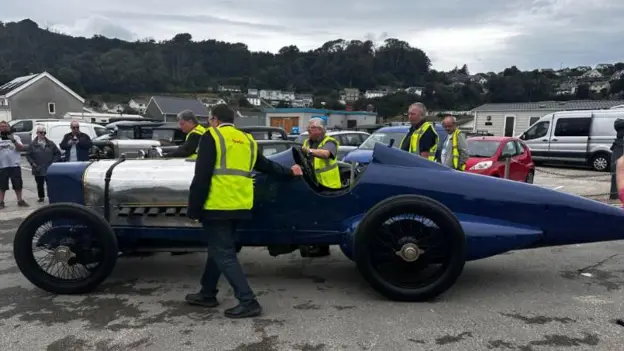

In the summer of 1925, on a windswept stretch of Carmarthenshire coastline, history was made—not just for Britain, but for the entire automotive world. Pendine Sands, the long, flat beach in south-west Wales, became the crucible of speed and ambition when Sir Malcolm Campbell thundered into legend.
Armed with a 350-horsepower Sunbeam dubbed Blue Bird, Campbell was determined to crack a milestone many thought unreachable: 150 miles per hour. He had already flirted with greatness, having both set and lost the land-speed record several times. But on 21 July 1925, before a global press corps and a captivated nation, he did more than break a record—he shattered a psychological barrier.
Across two runs, Campbell averaged 150.766mph (242.8 km/h), and the world took notice. The feat catapulted him to international fame, earning royal praise and front-page headlines. But it also secured Wales’ quiet sands as the birthplace of modern speed.
A century on, Blue Bird returned to Pendine—not to race, but to remember. The machine was ceremoniously brought onto the beach once more, this time under the gaze of Sir Malcolm’s grandson, Don Wales, himself a stalwart of a family whose obsession with speed borders on hereditary.
“It’s in the blood,” said Mr Wales. “Grandad’s buccaneering Scottish roots certainly played a part, but there’s something about chasing limits that binds us all together.”

And the lineage is nothing short of extraordinary. Sir Malcolm’s son, Donald Campbell, remains the only individual to have held both land and water-speed records simultaneously—a daring legacy that ended in tragedy during a 1967 attempt at Coniston Water. His daughter Gina etched her own name into the record books as the fastest woman on water. Don Wales, too, has tasted triumph, setting records in electric, steam-powered and even lawnmower speed categories.
“Racing doesn’t care what you drive,” Mr Wales reflected. “When the red mist comes down, all that matters is the line in the sand and how fast you can cross it.”
Pendine’s Golden Era
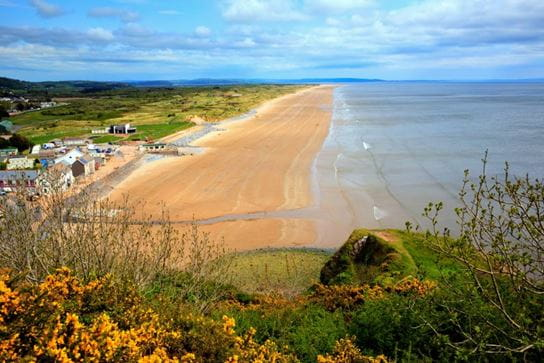
In the 1920s, Pendine wasn’t just a beach—it was the epicentre of a global obsession. Its vast, hard-packed sands offered the perfect stage for feats of speed that had outgrown England’s racetracks like Brooklands. Between 1924 and 1927, Campbell and his Welsh rival, the Wrexham-born engineer John Godfrey Parry Thomas, vied for supremacy.
Their battle pushed the land-speed record from 140mph to 176mph (225 to 283km/h). Where Campbell’s Blue Bird was a refined racer adapted for high velocity, Parry Thomas’s Babs was a beast built purely for raw power. Their contrasting philosophies and styles only deepened public intrigue.
Sadly, the race ended in heartbreak when Parry Thomas was killed at Pendine in 1927. Yet his courage—and Wales’ central role in pushing humanity’s limits—was never forgotten.
“I think Grandad respected Parry immensely,” said Mr Wales. “They were chasing the same dream, just in different machines.”
Legacy, Loss and Revival
After its moment of glory, Blue Bird slipped into obscurity. By the 1950s it was languishing in a barn, nearly forgotten. Eventually brought to the National Motor Museum at Beaulieu, it remained static for more than 30 years until an ill-fated attempt to restart the engine in 1993 ended in mechanical disaster.
Ian Stanfield, Beaulieu’s chief engineer, recounted the ordeal. “She hadn’t been touched in decades. But there was pressure to bring her to life. We knew better, but did it anyway—and the engine paid the price.”
Rebuilding the car was a Herculean task. The original Sunbeam factory in Wolverhampton had been bombed in the war. With no blueprint and almost no budget, engineers begged, borrowed and fabricated parts, taking a decade to bring Blue Bird back to life.
Today, the worry isn’t mechanical—it’s generational. “We’re losing the skills,” Stanfield warned. “It’s been my life’s work. But who will keep her running for the next hundred years?”

Speed’s Future—and Wales’ Place in It
For Don Wales, the legacy isn’t just nostalgic—it’s an invitation.
“A hundred years ago, no one knew if 150mph was possible. Now, there are projects aimed at 1,000mph. If the public—and industry—have the will, it can happen again.”
The biggest challenge? Geography. As speeds climb, so too do the demands for longer, flatter, safer surfaces. While Pendine no longer suits cutting-edge attempts, its symbolic place in the story of speed is unshakeable.
“Pendine is sacred ground,” Wales said. “It’s where Britain—where Wales—proved that the impossible was just a target waiting to be broken.”