

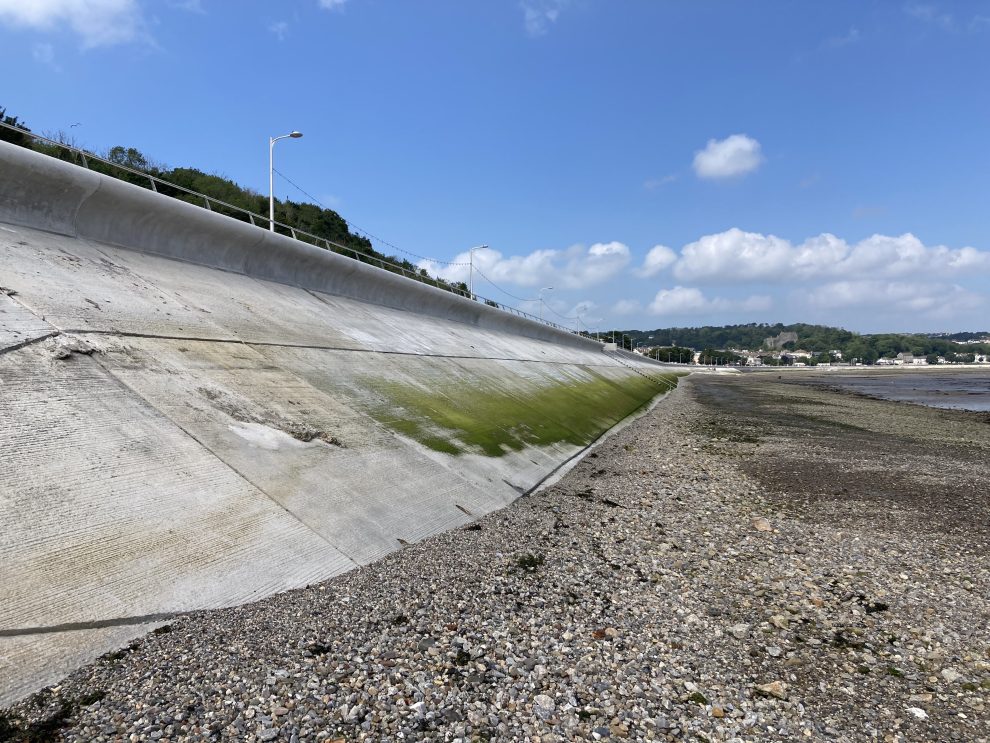

SPENDING £210,000 of public money to defend a house from coastal flooding in an affluent area of Wales might normally raise an eyebrow or two, but the Mumbles seawall and promenade project does much more than that.
The £26.5 million scheme is designed to protect 126 homes and businesses from rising sea levels for the next century, which works out £210,317 per property.
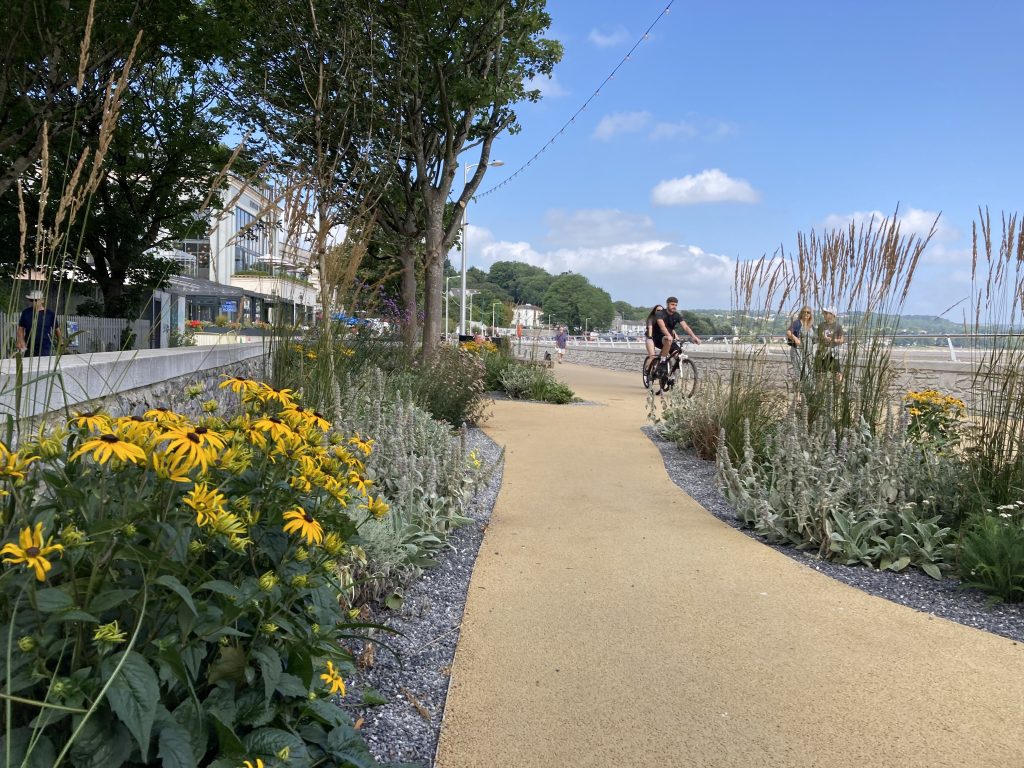
Contractor Knights Brown has also widened the promenade and topped it with a sandy-coloured resin, added seating, play areas and greenery. It feels more in keeping with what is a holiday destination.
Newly-planted rudbeckias wave in the breeze and the 1.2km stretch of new promenade is busy with people enjoying the summer holidays.
There has been disruption over the past two-plus years and there is more work to do although the project was officially opened last week by Deputy First Minister Huw Irrance-Davies, who described it as magnificent.

Designing flood protection schemes is complicated and councils which submit bases cases for them to the Welsh Government are competing for a finite pot of money.
Doing nothing wasn’t an option in Mumbles, said Swansea Council, which commissioned the project and contributed 15% of the cost.
“Despite ongoing maintenance the wall had fallen into in poor condition due to its age – it dates back to the 19th century,” said a council spokesman.
“There were significant cracks, some exposed footings and the possibility that it could fail in a major storm. A main sewer runs beneath the prom, retained by the defences; failure of the seawall could harm the natural environment as well as homes and businesses.
“Without new sea defences the risk of flooding would have kept on rising. Homes, businesses, community facilities, council resources and tourism income for the area would have been at risk.”
The authority evaluated various options and costs. An original scheme costing £14 million was superseded by the one in place now.
Knights Brown has brought the prom up to one level as it previously had dipped gradually from either end by around half a metre in the middle section. It has strengthened the main structure, replaced the previous railings with a wall topped with a handrail, and improved the area as a visitor destination.
There are said to be more than 245,000 properties at risk of flooding from the sea, rivers and surface water in Wales and not all of them can be defended.
The Welsh Government has allocated £291 million over five years for 15 coastal risk management schemes, like the one in Mumbles, protecting around 14,000 properties. Nine have been completed and six are ongoing.
Councils and other bodies with flood risk responsibility such as Natural Resources Wales (NRW) need to prove there is a robust case for a flood management scheme that offers best value for money, is commercially viable and can be completed successfully. Complicated projects may require strategic outline, outline and full business case approval.

Behind the scenes four shoreline management plans cover Wales’ coastline, drawn up by councils, NRW and other relevant parties.
Shoreline management plans split the coastline into small sections and set out four approaches to managing them over the short, medium and long term. The approaches are:
- Hold the line, by maintaining or changing the existing standard of protection
- Managed realignment, which allows the shoreline to move backwards and forwards in a managed way
- No active intervention, where there is no investment in coastal defences and natural processes take over
- Advance the line, by building new defences on the seaward side of the original defences.
It is a little more complicated though as there can be sub-categories within the four approaches, meaning for example that small-scale interventions could be allowed in a section with a “no active intervention” approach.
Shoreline management plans are non-statutory but help inform long-term investment decisions and statutory processes like marine licensing and planning.
Clive Moon, chairman of Swansea and Carmarthen Bay Coastal Engineering Group – the body responsible for the shoreline management plan incorporating Mumbles – said any significant changes to the plan would trigger a process involving the Welsh Government and NRW.
He said the plan’s policies were reviewed in 2021 against the latest data, including sea level rise estimates, and generally found to be robust.
Asked by the Local Democracy Reporting Service if it was likely or inevitable that more sections of the coastline will move from “hold the line” to “managed realignment” and “no active intervention” as a result of rising sea levels, and whether “no active intervention” could mean some coastal communities having to relocate, he said a small number would move to “managed realignment” and “no active intervention”.
Mr Moon said: “Whilst the exact timing and trigger for change will vary, many affected coastal communities will need to adapt to the impacts of flooding or coastal erosion. How each community adapts will be unique and likely change over time as the actual rather than predicted impacts of flooding and coastal erosion play out.
“There will always be uncertainty about how rapidly changes on the coast will occur, but the shoreline management plan can help by identifying a clear direction of travel to communities.”
He added: “There will inevitably be difficult conversations, but these communities must be involved in decisions about adaptation, just as their community representatives were involved during development of shoreline management plan policies.”
In Mumbles, the owner of the Oyster Wharf development, James Morse, said he believed the seawall and promenade project was a real success despite the “hassle” of the construction work.
“We sat down as part of a consultation about two years before they even started, and in fairness it could not have worked out better,” he said. “I’m exceptionally happy with the result.”
Another business owner, though, said the work has now spanned three summers and that parking problems had worsened. The man, who asked not to be named, said the first thing customers talked about was problems with parking.
Footfall, he added, was down. “People have got it in their heads that Mumbles is a building site,” he said.
But he felt the seawall and promenade was going to be an asset when it was completely finished.
John Williams, who has lived in one of the houses protected by the new seawall for 20 years, welcomed the investment. “It looks great,” he said.
Mr Williams said he could recall two instances of coastal flooding when the water overtopped the previous wall and through a gap, stopping close to his property.
“It needed to happen otherwise we will be flooded in the future,” he said. “We have not complained about anything.”
His view of the bay is more restricted at ground floor level than it was, and Mr Williams said it had come “as a bit of a shock” that the level of the prom was raised as well the new seawall being built.
He said maintenance of the new infrastructure and its many plants was important. “It looks nice and shiny now, it’s not going to look shiny forever,” he said.
How far sea levels will increase as a result of climate change is a key area of focus for climate scientists.
A review of climate, ice sheet and sea level rise data by academics at Durham University and Bristol University this year concluded that existing predictions of worldwide sea level rise of 1 to 2 metres over many centuries – if the rise in temperature could be limited to 1.5C – needed to be brought forward.
This was because of greater than anticipated melting of vast ice sheets. One of the report’s authors described the observed loss of ice in Greenland as “really quite staggering”.
Although countries’ commitments to act on climate change have brought down the predicted rise in temperature by 2100 that had been feared earlier, the study said the world was nevertheless on course for warming by 2100 which would trigger long-term ice-sheet loss raising oceans and seas by in excess of 12 metres.
And that would spell the end of the cheerful rudbeckias in Mumbles, and much else besides.