

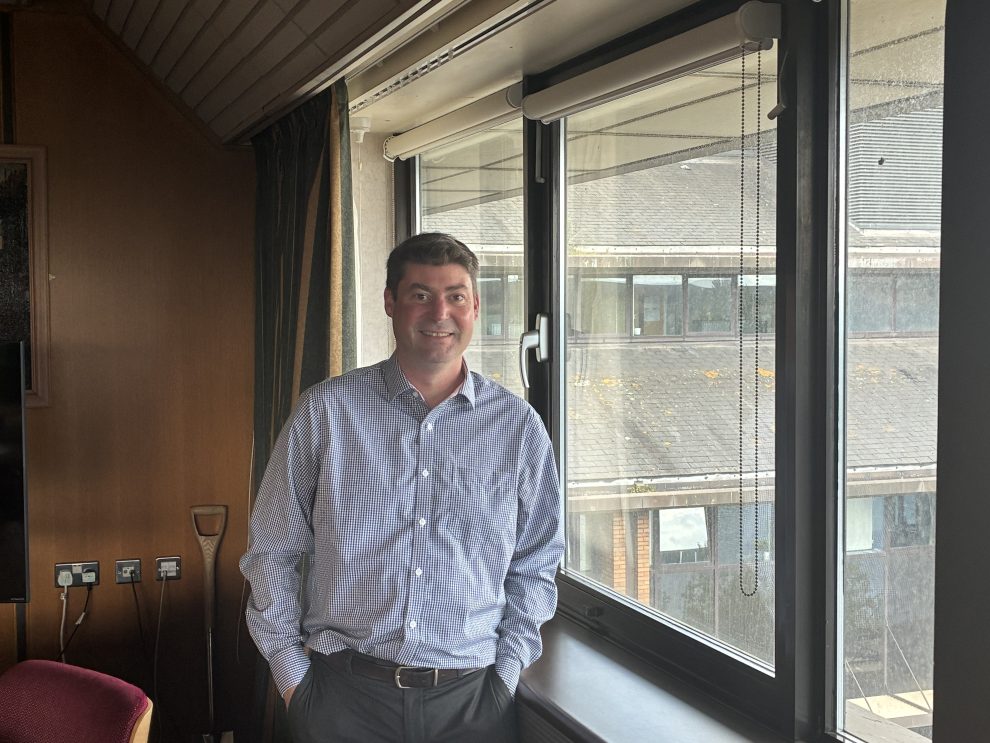

THE NEW Cardiff council leader has been challenged on the issues facing the city as he steps into the role.
Chris Weaver has recently taken charge of Cardiff council after his predecessor, Huw Thomas, was elected to the Senedd in the 2026 election.
Cllr Weaver had previously served as the council’s member for finance since 2017.
In an interview with the Local Democracy Reporting Service the new leader spoke about many issues affecting the city and the plans for his administration before the local elections in 2027.
When asked about the key areas he wanted to prioritise during his tenure as leader the newly-elected leader said he was focused on seeing through many of the projects started by his predecessor including the revamping of Cardiff Central station, the International Sports Village, and the wider regeneration of Atlantic Wharf.

When pushed about new developments he would like to see started he said he would look at “all areas of the city” for opportunities but stressed that “seeing through the projects we are already beginning with is very important”.
When asked about how he would like to differentiate himself from Mr Thomas he said young people missing out on education, employment, and training opportunities was an issue that needed a “pretty urgent focus” this year.
In Wales Cardiff Council has the largest debt of any local authority, reaching £980m last year.
On this the leader said: “I think when you talk about borrowing that the council does it’s really important to understand how a council borrows.
“We do not borrow to deliver our day-to-day services, unlike the UK Government, which runs up a national debt because it’s running a deficit.
“We don’t run deficits – we have a balanced budget every year. The borrowing we do is to invest in our capital programme.”
Examples he gave of this investment were the city’s council house programme and regeneration projects.
He added: “If you don’t invest in a city you can end up costing yourself more.”
On the topic of litter – a frequent bugbear of residents, particularly in some parts of the city – the leader spoke about how the council has put “a little extra money in the budget” to tackle the problem as well as additional street cleaning and improving the recycling rates.
Cllr Weaver represents Cathays ward, a known littering hotspot in the city, and because of this he acknowledged the need to clamp down on problem areas like Cathays and other inner-city wards and impress on people how “antisocial” it is.
However when asked if the council would be more aggressive in issuing fines to dissuade people from littering or fly-tipping he could only say that the council could do so “potentially”.
He said: “We do issue notices, we do issue fines, and I think those powers that we will have to continue to use if people continue to listen that way.”
Houses in multiple occupation (HMOs) have recently become a hot topic in the city with applications routinely receiving complaints from neighbours about their impact on the local area. Indeed Cllr Weaver has objected to many HMO plans in his ward along with the other Cathays councillors.
On this topic, he said: “Some HMOs are a really valuable form of housing within the city.
“Our issue is the overconcentration [of HMOs] – it brings a lot more of these problems, including waste.”
The issues he laid out caused by overconcentration included “[a] much more transient population, more issues with litter, noise, and overcrowding”.
Transport is another issue that frequently excites debate in the Welsh capital with the busy state of the city’s roads often leading to hold-ups.
In 2023 the council announced it would look at different ideas for a road user charge to improve air quality and reduce congestion in the city and one of these ideas was for a congestion charge.
Three years later, when asked if he had any plans to bring a congestion charge to Cardiff during his tenure as leader, Cllr Weaver responded that the council would be “carrying on the process that we’ve been going through over the last few years” meaning consultations.
He said this was because the council is looking through a “range of options” and he expects that they will bring forward another paper “in the summer this year [or] early autumn” but there’s “nothing concrete” yet.
Potholes in Cardiff have received a lot of attention in the city with many people becoming exasperated at the problem.
On tackling this problem Cllr Weaver said: “We will look at whether there’s any new technology you can use, new techniques of repairing potholes.”
The former finance member also pointed to the increased funding that has been put towards road maintenance.
He added: “The weather this year was exceptionally bad and they were coming up so fast but we will take a review over how effectively we were able to deal with what was probably the worst year for potholes.”
When asked if, due to new technologies or techniques, the council would consider more aggressive action in fixing roads he said it “absolutely” would.
“We recognise that it is really important to fix potholes for keeping people moving whether on bikes or cars. It is dangerous not to fix them.”