

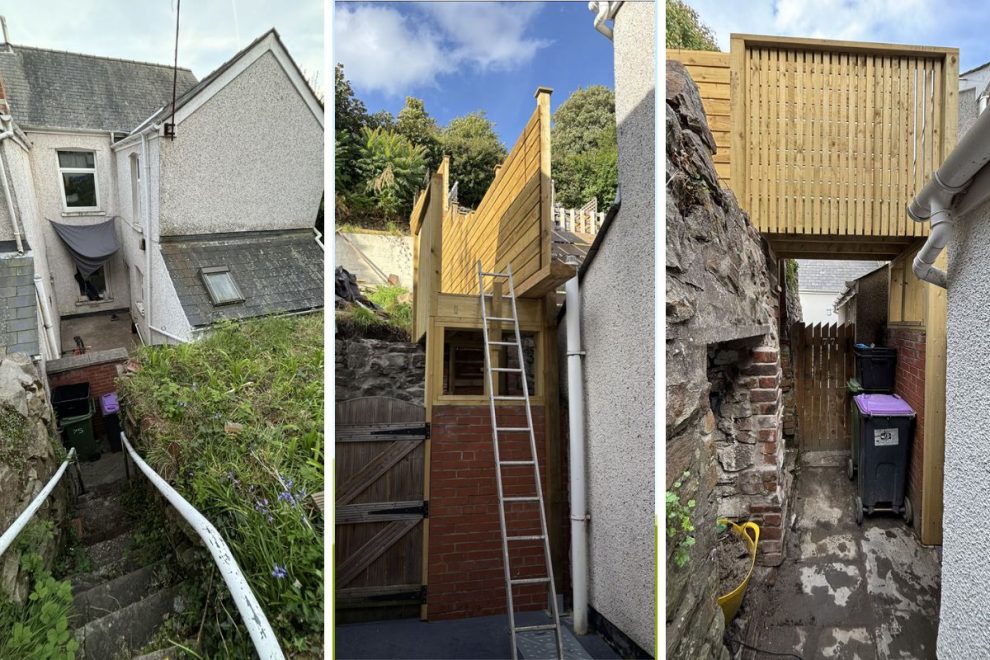

A HOMEOWNER has lost a bid to keep a large timber fence and staircase leading from a terraced street to a steeply sloping back garden.
Construction work had already started on the staircase which includes a raised platform 2.7 metres above a narrow, private access lane between the two homes and leading to their back gardens.
It was intended to replace the original stone staircase leading through the large, tiered garden that rises to the street above.
The new staircase and one metre long and four metres wide platform, partially enclosed by a two metre high timber fence, was dismissed as “overbearing and unneighbourly” by council planning officers who refused planning permission for the structure in November last year.
Homeowner Ben Davies appealed that decision, to Planning and Environment Decisions Wales, which sent independent inspector Nicola Gulley to view the staircase, which was partially constructed, at his property on Manor Road in Abersychan, Pontypool.

She agreed with the council and upheld the refusal and stated in her report it would have a harmful effect on Mr Davies’ own home as well as his neighbours.
Ms Gulley stated: “The proposed development would have a harmful effect on the character and appearance of the appeal dwelling and on the living conditions of the occupiers of the neighbouring property.”
As such Ms Gulley said the structure was at odds with the council’s planning policy as it failed to take account of the local context in its appearance and would have an unacceptable impact on the amenities of those living in neighbouring homes.
Mr Davies had argued the staircase and supporting platform was “a proportionate response to a constrained, steeply sloping site with long-established changes in ground level” and disputed it would cause harm to the character of the area or his neighbours’ living conditions, and suggested conditions could control any adverse impacts.