

ON THE MORNING of October 21, 1966, the village of Aberfan was preparing for the final day of school before half-term.
Children hung up their coats. Teachers called the register.
High above them, the mountain was already beginning to move.
A disaster decades in the making
The origins of the tragedy stretched back half a century.
In 1916, the nearby Merthyr Vale Colliery ran out of tipping space on the valley floor. Instead, waste from the mine was piled on the mountainside overlooking the village. Over the following decades, seven vast spoil tips were constructed above homes, farms and schools.

By 1966, only Tip 7 remained active.
Crucially, it had been built partly over natural underground springs — a fact known to management — making the tip dangerously unstable. In the days before October 21, persistent heavy rain soaked the valley. Water accumulated inside the tip, saturating the coal waste until it became a dense, mobile slurry.
Residents had warned repeatedly about the danger. Letters were written. Complaints were raised at meetings. Smaller slips had already occurred from the same tip in previous years.
Those warnings were ignored.
The collapse
Shortly before 7:00am, Tip 7 began to shift.
Witnesses later described a deep rumble rolling down the mountainside “like thunder”.
At approximately 9:15am, the saturated tip collapsed.
Around 140,000 cubic yards of liquefied coal waste surged downhill with devastating force.
In its path lay the farmhouse and cottages at Hafod Tanglwys Uchaf. They were obliterated, killing everyone inside.
Seconds later, the avalanche struck the village.

Eighteen houses were destroyed. Pantglas Junior School was engulfed. Part of the neighbouring secondary school was badly damaged. Classrooms filled almost instantly with thick black slurry and debris as the landslide finally came to rest on Aberfan Road.
Moments earlier, children inside had been singing All Things Bright and Beautiful.
Within seconds, there was silence.


The desperate rescue
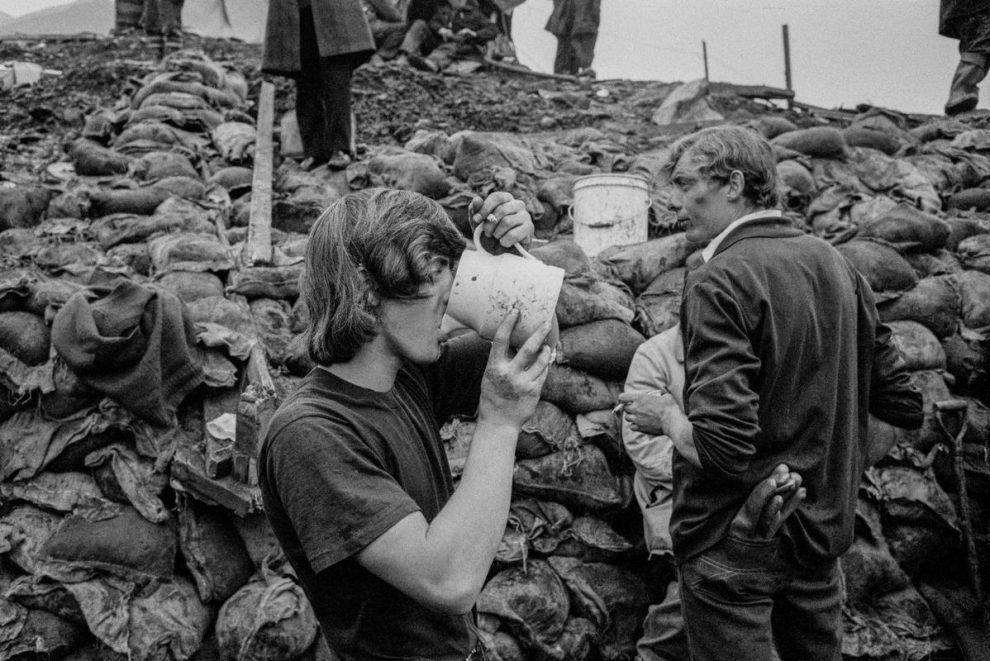
Miners from nearby pits were among the first to arrive. Still in their work clothes, they ran towards the devastation, digging with bare hands.
Parents clawed at the debris. Neighbours formed human chains. Police and rescue workers joined them, but mechanical equipment was scarce during the crucial early hours.
Voices could initially be heard beneath the rubble.
The last child to be pulled out alive was rescued at around 11:00am. After that, hope faded, though bodies continued to be recovered for days.
In total, 144 people died — 116 children aged between seven and ten, and 28 adults.
Among the teachers, only four survived: Mr Williams, Mair Morgan, Hettie Williams and Rennie Williams.
The small cemetery on the hillside would soon receive rows of white coffins.
An entire generation of a village was lost in a single morning.
A nation in mourning
The scale of the disaster sent shockwaves across Britain and around the world.
Prime Minister Harold Wilson visited shortly afterwards. Eight days later, Queen Elizabeth II travelled to Aberfan with Prince Philip — a delay she would later describe as one of her greatest regrets.
On October 27, a mass funeral took place. Dozens of small white coffins were carried through the village in scenes broadcast across the nation. Schools across Britain observed silence. Messages of condolence arrived from every continent.
Donations poured in from around the globe, eventually totalling £1.75 million — an extraordinary sum at the time — to support grieving families and rebuild the shattered community.
No amount of money could restore what had been lost.


The tribunal
An official inquiry was launched within days, chaired by Lord Justice Edmund Davies, himself from a mining family.
After 76 days of evidence, the conclusions were unequivocal.
The National Coal Board was found fully responsible.
Lord Justice Davies stated the disaster had been caused by “ignorance, ineptitude and a failure in communications.” He rejected any suggestion it had been unforeseeable.
Despite the damning findings, no individual was prosecuted and no senior official resigned.
For many in Wales, that absence of accountability deepened the sense of injustice.
The second blow
Attention quickly turned to the remaining spoil tips still looming above Aberfan. Parents demanded their immediate removal.
Controversy erupted when the National Coal Board refused to meet the full cost.
In a decision that caused widespread anger, the Government allowed £150,000 to be taken from the Aberfan Disaster Relief Fund — money donated by the public for bereaved families — to help pay for the work.
To many, it meant the victims were effectively paying for the mistakes of those responsible.
Decades later, in 1997, the Government repaid the money, acknowledging the injustice.
Lasting impact
The disaster led directly to new safety legislation, including the Mines and Quarries (Tips) Act 1969, which introduced stricter controls over spoil tip management.
But its impact went far beyond law.
Survivors have spoken of lifelong trauma, survivor’s guilt and a silence that settled over the village for decades. For many families, grief was carried privately and permanently.
Today, the site of Pantglas Junior School is a memorial garden.
In the cemetery above the village, rows of white arches mark the graves of many of the children who never came home.
Each year, services of remembrance are held.
The Aberfan disaster changed Britain. It reshaped attitudes to industrial safety and corporate responsibility. It remains one of the defining tragedies of modern Welsh history.
But beyond politics, legislation and inquiries lies a simple, enduring truth.
On October 21, 1966, 116 children went to school.
They never came home.
And Wales has never forgotten.