
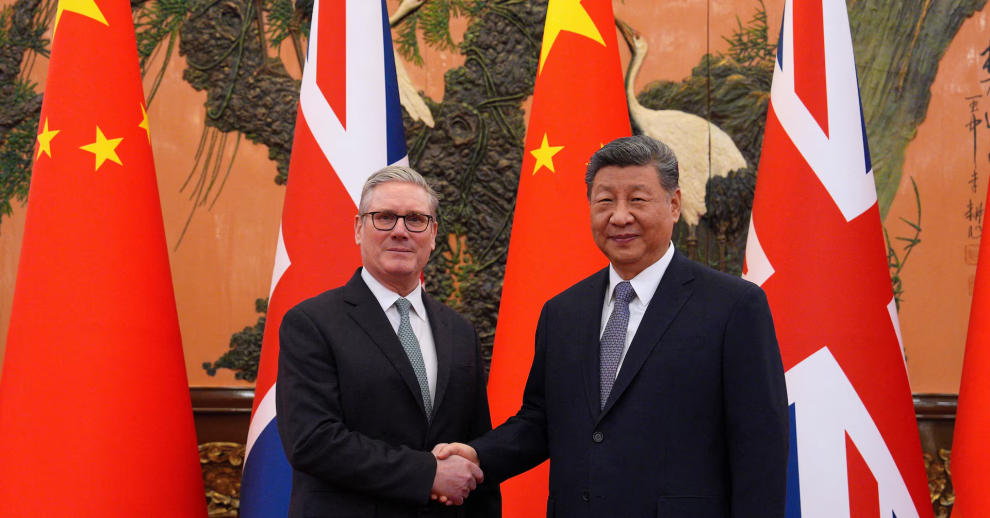
China has lifted all sanctions imposed on six serving British MPs and peers, Prime Minister Sir Keir Starmer has said, following talks with President Xi Jinping.
Speaking to the BBC in Shanghai, Sir Keir said travel bans and other restrictions placed on the parliamentarians “no longer apply”, describing the move as a significant outcome of his visit to China.
Those affected include four Conservative MPs and two members of the House of Lords. Sir Keir said the decision “vindicated” his approach, arguing that direct engagement had created the opportunity for “leader-to-leader discussion on sensitive issues”.
However, the parliamentarians who were sanctioned said they did not want to be “used as a bargaining chip” and would prefer to remain under sanction.
In a statement, China’s foreign ministry said the two sides had agreed “in principle to resume normal exchanges between the legislatures of the two countries”.

“China welcomes British parliamentarians who have the willingness to visit China more and experience the real China,” it added.
The sanctions were imposed by Beijing in 2021. Those targeted included Conservative MPs Sir Iain Duncan Smith, Nusrat Ghani, Tom Tugendhat, Neil O’Brien and Tim Loughton, who is no longer an MP. Labour peer Baroness Kennedy and crossbench peer Lord Alton were also sanctioned. All are members of the Inter-Parliamentary Alliance on China.
The measures barred them from entering mainland China, Hong Kong and Macau, froze any property they held in China, and prohibited Chinese individuals and institutions from doing business with them.
At the time, then prime minister Boris Johnson said the sanctioned figures were “shining a light” on what he described as “gross human rights violations” in China.
China has been accused of committing crimes against humanity against the Uyghur population and other predominantly Muslim ethnic groups in the north-western region of Xinjiang — allegations the Chinese government has consistently denied.
The UK has not lifted any sanctions on Chinese individuals, and it remains unclear whether restrictions have been removed from others sanctioned by Beijing, including Mr Loughton, who stood down at the 2024 general election.
Also sanctioned were Sir Geoffrey Nice KC, chair of the Uyghur Tribunal investigating alleged atrocities against the minority group, and Newcastle University academic Dr Jo Smith Finley, whose research focuses on the Uyghurs.
In their joint statement, the sanctioned parliamentarians said they would “rather remain under sanction indefinitely than have our status used as a bargaining chip to justify lifting sanctions on those officials responsible for the genocide in Xinjiang”.
They added: “We will not accept any reprieve that applies only to sitting lawmakers while others, including civil society organisations, remain sanctioned.”
Sir Keir’s three-day visit — the first by a British prime minister since 2018 — is part of a wider effort to reset relations with China, the world’s second-largest economy after the United States.

Following talks with President Xi at the Great Hall of the People in Beijing, the prime minister said the UK’s relationship with China was now in a “good, strong place”.
Downing Street has pointed to the lifting of the sanctions as one of several “clear wins” from the trip. Sir Keir said he had raised the issue directly, describing it as “a cause of concern”.
“The fact that those restrictions have now been lifted rather vindicates my approach,” he said. “It’s only because we’re here that we’ve had the engagement needed for those sensitive discussions.”
Nonetheless, critics have voiced concern about closer ties with Beijing, citing China’s human rights record and what they see as a threat to UK national security.
The Conservatives have accused Sir Keir of “kowtowing” to China and argued that he should not have made the visit. US President Donald Trump has also criticised the move, warning that doing business with China was “very dangerous”.
Downing Street responded by saying Washington had been informed of the visit and its objectives in advance.