

FAMILIES across Wales have been promised free childcare for all children aged nine months to four years by 2031, but the proposal could cost up to £500m a year.
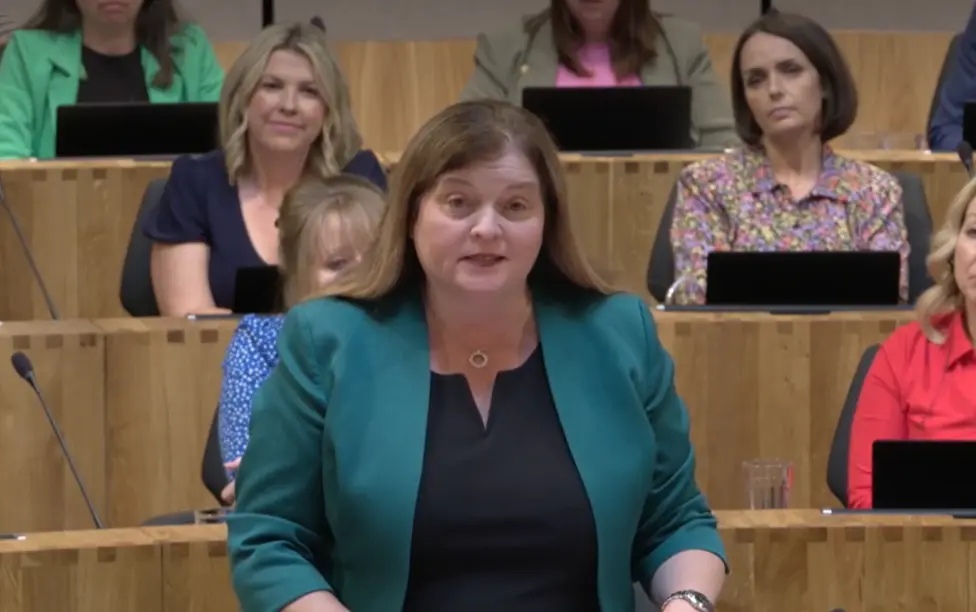
Wales’ Deputy First Minister Sioned Williams told the Senedd on Tuesday July 14 that the Welsh Government’s core estimate for the full rollout is £375 million annually.
However, Ms Williams admitted under questioning that the final bill could rise to half a billion pounds depending on uptake
Ms Williams said: “Families of all children from nine months to four years across Wales should be able to access a more affordable, simpler, more consistent childcare offer by the end of this Senedd term.”
Describing childcare as “absolutely essential”, Ms Williams told the Siambr that whether or not to expand funded childcare is “not a question to discuss.”

She said: “The lack of affordable childcare is a societal problem to solve, and in solving it, we will deliver benefits that span across gender equality, early child development, tackling poverty, supporting our economy and improving our children’s health and educational outcomes.”
Ms Williams said work with economists and analysts was “ongoing”, and said factors such as workforce costs, training and development, additional learning needs and more will also be taken into account.
She pointed to the fact funded childcare was offered to nearly 75% of two-year-olds across Wales in 2025/26, the minister said: “We want to go further and ensure that what was promised by the previous Labour government, but not delivered, is fully implemented.”
Ms Williams highlighted the importance of the supplementary budget – which was later that day rejected – in enabling the childcare offer rollout.
She said: “At the start of this government term, three local authorities had succeeded in completing the roll-out of 12.5 hours of funded childcare to all two-year olds. One other local authority has reached every two-year-old child last month.
“And 16 more local authorities have already confirmed that, with the additional funding that we will invest through the supplementary budget, they’ll be able to move to a full rollout by the end of this financial year”.
She added: “Wales has the highest childcare costs in the UK, with many households spending more than their rent or mortgage on childcare costs. Women are disproportionately affected by this and Wales has a persistent gender pay gap.
“Wales has some of the poorest children who cannot currently access the benefits of early years provision.”
Reform’s Christiana Emsley, who is the party’s shadow minister for families, told the Deputy First Minister that “ambition is not the issue; preparedness is”.
Ms Emsley said that a want for children to have “the best possible start in life” and for families to be able to access “affordable, high-quality childcare” is something that unites everyone across the Siambr.

However, she criticised the Deputy First Minister’s statement suggesting it contained a “contradiction at its very heart”.
The Fflint Wrecsam MS said: “You tell us that, whilst developing the manifesto, Plaid Cymru, quote, ‘carefully costed’ the expanded childcare offer, yet only moments later you tell us that officials are now developing clearer costs, reconsidering the assumptions behind them, modelling potential take-up rates and testing a range of variables.”
Ms Emsley also questioned Ms Williams’ statement that the policy will cost £375 million a year, noting that the Deputy First Minister described this as a “mid-point estimate”.
She called on Ms Williams to reveal the government’s highest estimate – but the minister took aim at Reform’s election manifesto – which contained no mention of childcare – in her response.
Ms Williams said: “We know that for years and years anti-poverty researchers and people who are trying to promote equality in Wales and in our society have seen this as a keystone, a foundational part of addressing that inequality.
“And yet all we get from Reform is talk about a worst-case scenario, a financial liability.”
Responding to Ms Emsley’s comments on the midpoint estimate, Ms Williams said the figure is based on the take-up that has been seen in other parts of the UK with similar demographics.
She confirmed her government does know the potential full cost and said: “The maximum is usually about 80% take-up.
“The additional funding that would be needed would be between £250 million and £500 million. The £375 million is a midpoint estimate.
“The precise funding will always depend on take-up rates. We have to have estimates and modelling around all those scenarios. That’s why the work is ongoing.
“It’s not about making a plan, it’s about making sure that we can deliver what is actually needed as we work through these phases.”
The Deputy First Minister was also questioned on her plans for the Flying Start scheme.
Former education minister Lynne Neagle – who is Labour’s spokesperson for children – told the Siambr that Flying Start provision provides better health visiting, speech and language therapy, and parenting support.
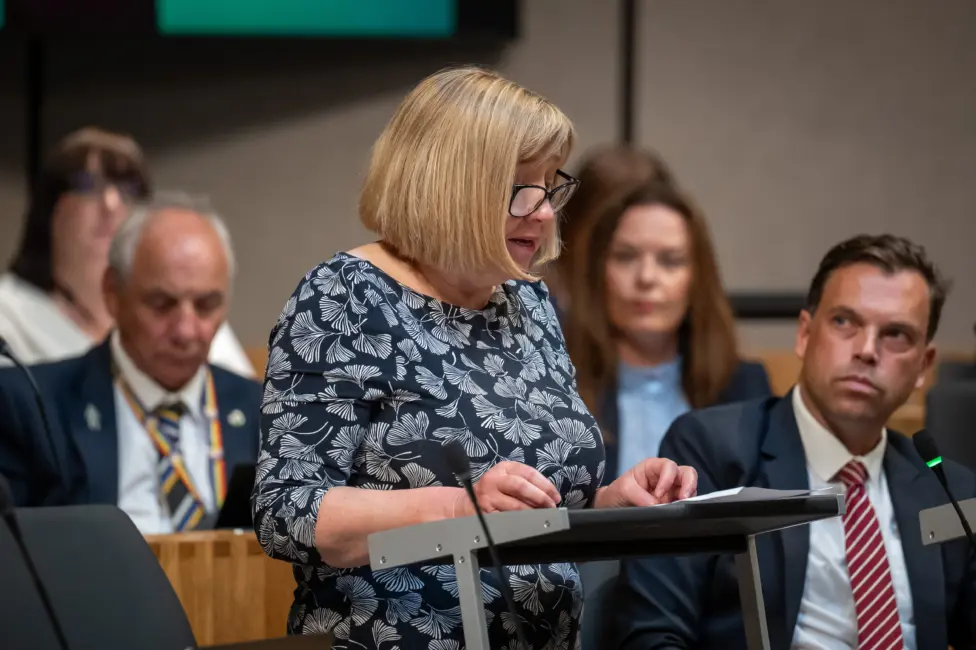
Ms Neagle asked what the “ramifications” of Plaid’s childcare plans will be for Flying Start – and whether there could be a reduction in the number of children receiving all four elements of Flying Start to fund the new offer.
Ms Williams said: “As regards Flying Start, as I’ve said, this isn’t about […] just adding hours; absolutely not.
“This is about taking a system-wide approach to transforming support for children in the early years.
“Childcare, as I said, is our manifesto commitment. It’s absolutely a key part of that, and so, […], the immediate priority is to make sure that we can start that work of rolling out what we’ve promised to the Welsh electorate, and then build, as I say, towards the next stages of expansion”.
The Welsh Conservatives described the current system as “far too complex”.
Sam Rowlands, Tory spokesperson for families, said: “We believe that one of the first things that the Welsh Government should be looking at is how to streamline and simplify childcare funding so that parents in particular can easily understand what support is available to them so that they can properly plan for the future.”

Responding to Mr Rowlands’ question on what will be done to engage with parents and carers, Ms Williams said: “We know that many people don’t take up childcare, not only because it’s disjointed, but because it’s difficult, it’s complex, and there are so many different eligibility thresholds, things you’ve got to apply for at different points during your child’s life.
“So, I can assure you that the point around simplification and what that looks like, what that front door looks like, is absolutely part of this work as well. And my officials are already working on that.”
Mr Rowlands also quizzed the Deputy First Minister on a proposal put forward in the Conservative manifesto – a “grandparent payment scheme”.
The Tory spokesperson described the proposed scheme as designed “to recognise the role of the wider family in bringing up children”.
He continued: “You say that it takes a village to bring up a child. I wonder what consideration you’ve given to a scheme similar to that, where a nominated family member is able to be supported to support bringing a child up, rather than, perhaps, necessarily, that money always going to a childcare provider setting.
“At the end of the day, parents want childcare that is safe, affordable and reliable. Providers want a system that is properly funded, sustainable and workable. Those are the priorities that we should all be focused on.”
Ms Williams replied: “We are looking at creative solutions. We really need to consider childminders in this, who are constantly coming up as ‘excellent’ and ‘good’ when they’re inspected.
“They provide such a valuable service for people who work irregular hours, especially in places where there isn’t a density of population.
“So, we will absolutely be considering other models of provision as we roll this out.”