

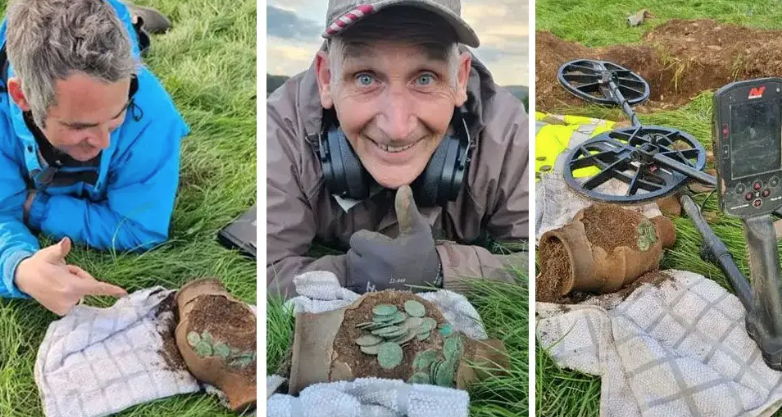

A metal detectorist from Cheshire may have uncovered the largest hoard of Roman coins ever found in Wales — a discovery experts believe could rewrite parts of the nation’s archaeological history.
David Moss, 36, was left “in disbelief” after unearthing two clay pots believed to contain between 10,000 and 15,000 coins during a recent detecting trip to north Wales.
“I had goosebumps,” he said. “A rainbow appeared minutes before the signal was found. I couldn’t believe it.”
The remarkable find left Moss so concerned about the coins’ safety that he spent three nights sleeping in his car with them before driving to Cardiff to hand them over to specialists at the National Museum. “I just didn’t want to leave it out of my sight,” he admitted.
The coins are now secured at the National Museum Cardiff, where experts will begin detailed analysis to confirm their age and significance. Early indications suggest the discovery could surpass all previous Roman hoards recorded in Wales.

“Virtually untouched” site
While Moss has chosen not to reveal the precise location for security reasons, he described the area as “virtually untouched” and steeped in history.
“You’re talking from the times of the druids and the Vikings right through to the Romans,” he said. “I just find it fascinating. It’s an area that I’ll be interested in for the rest of my life.”
Moss, who has been metal detecting for nearly a decade, has previously uncovered around 2,700 Roman coins, but nothing approaching the scale of his latest discovery. The hoard was found in August with the help of his friend Ian Nicholson, and the pair spent more than six hours carefully excavating the two pots.
Expert: “Likely the biggest in Wales”
Anthony Halse, 64, chairman of the South Wales and Monmouthshire Numismatic Society, believes the find could prove to be the largest in Welsh history.
“I would have thought that it was a person’s wealth that could be in a section of the army,” he said. “They’ll clean them and, since it’s such a large hoard, they will apply to the British Museum to see if they can keep them. Then they’ll go to the board and make the finder an offer. He’ll get half the money and the landowner will get the other half.”
The National Museum Cardiff confirmed that a full assessment is under way, with results expected next year. The largest known Roman hoard previously found in Wales contained around 10,000 coins discovered near Chepstow in the 1990s.
A rich tradition of hidden treasure
Throughout Britain, Roman coin hoards have been unearthed in fields, woodlands, and riverbanks — often buried deliberately during times of conflict or as offerings to the gods. In 2010, a discovery in Somerset yielded more than 50,000 coins, valued at over £320,000. In Wales, the largest previous find was made in Sully, Vale of Glamorgan, where nearly 6,000 coins were unearthed in 2008.
What to do if you find treasure
Under the Treasure Act 1996, anyone who discovers treasure in Wales must report it to a Finds Liaison Officer within 14 days of finding it, or within 14 days of realising its potential significance. Failure to do so can result in a fine or up to three months in prison.
Treasure is defined as any object at least 300 years old that contains 10% or more precious metal, or as a group of at least two coins over 300 years old meeting the same criteria.
Once reported, the find is examined by experts, and a coroner’s inquest determines whether it officially qualifies as treasure. If it does, the Treasure Valuation Committee recommends a fair market value, with any reward divided between the finder and the landowner.

Experts caution against cleaning or tampering with ancient finds, as this can cause irreversible damage. Instead, they advise carefully recording the discovery’s location and contacting the relevant authorities.
Lessons from the past
Not all discoveries end well. In 2015, Welshman Layton Davies was jailed after concealing his find of £3 million worth of Viking coins in Herefordshire. He failed to report the hoard to the authorities and attempted to sell items privately — a cautionary tale for detectorists across the UK.
As for David Moss, he remains humble about his find but proud to have contributed to Welsh heritage. “It’s something I’ll never forget,” he said. “To think those coins have lain buried for nearly two thousand years — it’s just incredible.”