

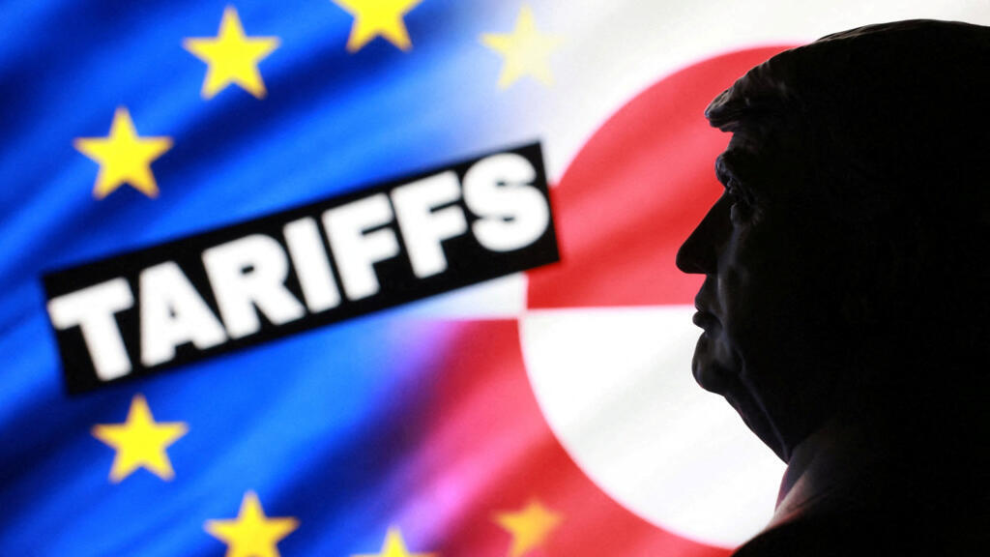

AFTER United States President Donald Trump threatened a trade war against European nations opposing his bid to acquire Greenland, Brussels is reportedly exploring the use of a so-called “trade bazooka” – a powerful, multi-layered economic instrument designed to deter coercion from non-EU countries.
The controversy was further inflamed when Norway revealed that its Prime Minister had received a message from Trump, suggesting that Oslo’s decision not to award him the Nobel Peace Prize may partly underpin his stance.
Trump’s Message to Norway
Norwegian Prime Minister Jonas Gahr Støre’s office confirmed on Monday that he had received a note from Trump, in which the former US president wrote: “Considering your country decided not to give me the Nobel Peace Prize for having stopped eight wars PLUS, I no longer feel an obligation to think purely of peace.”
He added: “Although it will always be predominant, I can now think about what is good and proper for the United States of America.” Trump also reiterated his doubts over Denmark’s ability to protect Greenland from Russian or Chinese influence. “The world is not secure unless we have complete and total control of Greenland,” he asserted.

The Tariff Threat
On 17 January, Trump announced via his Truth Social platform that he had effectively subsidised Denmark and other EU nations by refraining from imposing trade tariffs. From 1 February, he stated, exports from Denmark, Norway, Sweden, France, Germany, the UK, the Netherlands and Finland to the US would face a 10 per cent levy.
Trump warned that, from 1 June, the tariff would rise to 25 per cent “until such time as a deal is reached for the complete and total purchase of Greenland.” He claimed the US had pursued the island for more than 150 years, with previous presidential attempts repeatedly rebuffed by Denmark.
Danish and Greenlandic leaders have consistently maintained that Greenland – an autonomous territory within the Kingdom of Denmark – is not for sale. Recent demonstrations on the island have opposed Trump’s acquisition ambitions.
US Interest in Greenland
The US interest in Greenland is long-standing. After purchasing Alaska in 1867, Secretary of State William Seward tried unsuccessfully to buy the island. In 1946, President Harry Truman secretly offered Denmark $100 million, but Copenhagen refused; the proposal only became public decades later.
During World War II, the US occupied Greenland and constructed military facilities. Today, it maintains a presence at Pituffik Space Base.
Greenland, home to roughly 56,000 people – mostly Indigenous Inuit – lies geographically in North America but politically belongs to Denmark. The island withdrew from the European Community in 1985 following the introduction of home rule but maintains a special association with the EU, granting limited internal market access and EU citizenship via Denmark.
Its strategic location between the Arctic and North Atlantic Oceans provides the shortest air and sea routes between North America and Europe, making it crucial for US military operations and early-warning systems, particularly around the Greenland-Iceland-UK gap. Greenland’s economy is dominated by fishing, with locals opposed to large-scale mining. While oil and gas extraction is absent, the island contains substantial mineral deposits, including rare-earth metals critical to modern technology. Climate change and new Arctic shipping routes have further increased Greenland’s geopolitical significance.
Europe’s Response
European nations have stressed diplomacy before retaliation, though tariffs remain on the table. “Our priority is to engage, not escalate. Sometimes the most responsible form of leadership is restraint,” said European Commission spokesperson Olof Gill on Monday. However, he warned: “The EU has tools at its disposal and is prepared to respond should the threatened tariffs be imposed.”
EU members convened for an emergency meeting on Sunday. In a joint statement, the eight countries targeted by Trump – Denmark, Finland, France, Germany, the Netherlands, Norway, Sweden and the UK – expressed full solidarity with Greenland and stressed their commitment to dialogue “based on the principles of sovereignty and territorial integrity.”
UK Prime Minister Keir Starmer echoed this position, saying Greenland’s future should be determined solely by Denmark and Greenland. While he criticised the tariff threats, Starmer stopped short of advocating retaliatory measures, describing a tariff war as “not in anyone’s interests.” German Chancellor Friedrich Merz similarly urged dialogue, warning of economic harm on both sides of the Atlantic, though he did not rule out tariffs entirely.
Macron: Sovereignty, Co-operation, and Protectionism
French President Emmanuel Macron, speaking at the World Economic Forum in Davos, stressed that France and Europe are “obviously” committed to national sovereignty and independence. He said this approach is not “old-fashioned” but a necessary reminder of the lessons of World War Two, and that Europe must remain committed to co-operation.
Macron highlighted France’s participation in military exercises in Greenland, noting that the operations are “without threatening anyone but just supporting an ally in another European country – Denmark.”
Turning to trade, Macron took a strong protectionist stance. He criticised US competition for trade agreements that “undermine our export interests, demand maximum concessions and openly aim to weaken and subordinate Europe,” and condemned an “endless accumulation of new tariffs” as “fundamentally unacceptable.” He added that tariffs used to leverage territorial sovereignty are “even more unacceptable,” stressing that Europeans are the only ones not defending their companies and markets when other nations disregard a level playing field.
A source close to Macron confirmed that Trump’s threats to impose 200 per cent tariffs on French wine and champagne – in response to France declining his invitation to join a so-called “Board of Peace” – are considered “unacceptable.” Macron also noted that Europe’s competitiveness lags behind the US and called for urgent action to address underinvestment and stimulate growth.
The ‘Trade Bazooka’ – Europe’s Anti-Coercion Tool
Some EU leaders have called for a more forceful response, activating the Anti-Coercion Instrument (ACI), colloquially dubbed the “trade bazooka.” Designed to counter economic pressure from non-EU states, the ACI was proposed in 2021 and adopted in 2023. It enables measures such as steep retaliatory tariffs, investment restrictions, bans on public contracts for foreign companies, and limits on access to EU-based financial infrastructure.
The ACI is a last-resort tool. Implementation begins with a complaint alleging economic coercion, followed by a four-month EU Commission investigation. If confirmed, the Commission first seeks a diplomatic solution before a qualified majority of member states – at least 15 countries representing 65 per cent of the EU population – can approve activation. Full deployment may take up to a year.
Potential Impact
The US runs a substantial trade deficit in goods with the EU, importing less than it exports, while enjoying a surplus in services. Applying the ACI could target US tech firms, pharmaceuticals and aerospace industries, potentially affecting share prices. However, it would also impact European consumers and businesses through higher costs and reduced access to services and goods.
UK financial media report that the EU is considering €93 billion ($108bn) in tariffs on US goods as a first line of defence. Analysts suggest, however, that negotiations may ultimately prevail, with a compromise allowing the US greater access to Greenland’s resources and military presence while preserving Danish sovereignty.
US Political Voices Weigh In
Beyond Europe, US politicians have also commented on the dispute. Speaking at Davos, California Governor Gavin Newsom urged European leaders to “stand tall and firm” in response to Trump’s tariff threats.
“It’s time to get serious and stop being complicit. It’s time to have a backbone,” Newsom told reporters. A prominent critic of Trump and a potential 2028 Democratic presidential contender, Newsom’s remarks underscore the political dimension of the row in the United States as well as Europe.