

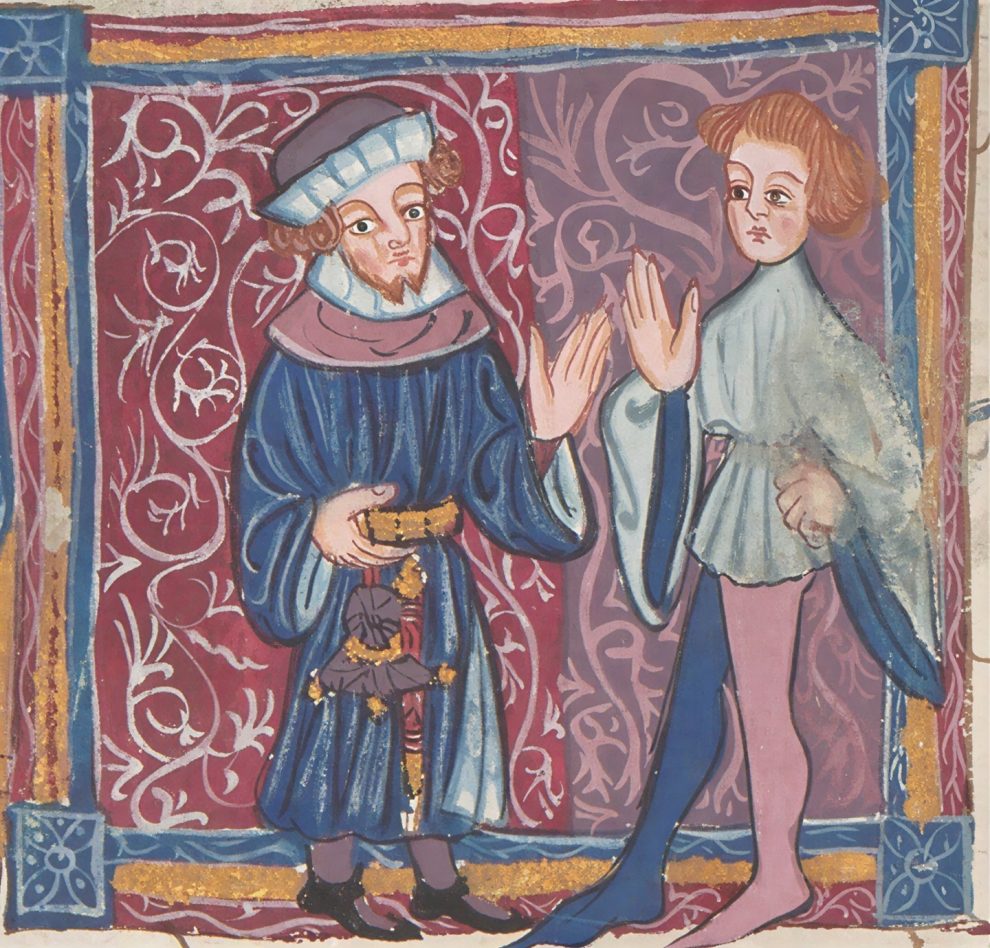

WELSH poets’ use of the language of love and intimacy to describe their relationships with powerful patrons is being explored as part of research at Aberystwyth University.
The research project is looking at medieval Welsh praise poetry in which court bards – poets who worked for local lords or princes – use the language of romance, affection and marriage when writing about their patrons.
In some texts, poets present themselves as spouses or intimate companions of their patrons. Similar patterns have been identified in medieval Irish literature, while the Welsh material has received less attention.
The academics aim to trace the origins and development of these writing traditions during the Middle Ages, and what they reveal about how relationships between men were understood in the past.
The research also examines how ideas of masculinity and gender are expressed in the poetry, particularly the role of the bard as a professional figure working at court.

The project considers how this poetry relates to wider European writing traditions, including influences from ancient Greek and Roman literature, and how the past is remembered and idealised.
Dr Simon Rodway, from the Department of Welsh and Celtic Studies and Principal Investigator, said: “Medieval Welsh praise poetry uses highly developed poetic language to describe relationships between poets and patrons. To modern readers, this language can seem surprising, but it reflects established ways of writing poetry within court culture, where loyalty and status were expressed in imaginative and stylised ways.”
“By studying these patterns, we can gain a better understanding of how writers used poetic language to shape ideas about status and relationships in Welsh society in the Middle Ages.”
Dr Kit Kapphahn, Research Fellow at Aberystwyth University, said: “These poems show that the relationship between poet and patron, while political and economic, was also expressed through poetry. The language of love and marriage was used to express loyalty, status and connection in medieval Wales by invoking the imagery of personal connection.
“What is striking is how consistent this language is across different texts and eras. It is part of established poetic traditions in which the bard played an important role in court society. Studying this helps us understand how medieval Welsh society considered ideas about authority, identity and belonging, and by exploring it ourselves, where some of our modern ideas come from.”
The research is part of the Amatory and Romantic Language in Welsh Panegyric project, funded by the Marie Skłodowska-Curie Actions.