

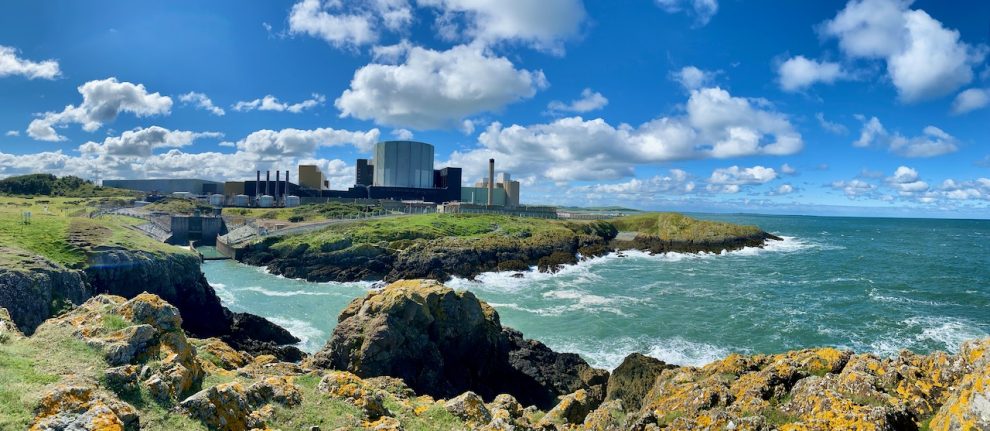

CAMPAIGN for the Protection of Rural Wales (CPRW), the Welsh countryside charity, is concerned with the increasing energy infrastructure proposals gathering pace across Wales. CPRW is calling for strategic, coordinated planning that safeguards Welsh landscapes while ensuring national energy needs are met responsibly.
More details have been emerging about the UK Government’s ambitions for nuclear on Ynys Môn in north Wales, with it being revealed by Simon Bowen, of Great British Energy-Nuclear, and Prime Minister Sir Kier Starmer, that the aim is for eight Rolls Royce small modular reactors (SMRs) to be located on the site, rather than the three previously understood. This could have wide ranging implications across much of rural Wales.
In addition, north Wales has been designated an AI growth zone which will increase projected power consumption in the region. This level of generation (3,750 MW) could produce sufficient electricity to meet twice the current electricity demand of Wales or 3/4 of the energy requirement for the whole of Wales in 2050. Major transmission grid reinforcement would be required for all this power. The first SMR is aimed to be generating by the mid-2030s with the other seven following “soon after”.
Current plans for energy generation and supply in Wales include:
- Offshore wind in the Irish Sea off north Wales, either operational, being built or consented to be commissioned by 2030 is around 2,500 MW, coming ashore at Bodelwyddan
- The Western Link subsea cable already brings up to 1,700 MW of wind power from Scotland into north Wales at Deeside
- Two subsea cables will bring up to 4,000 MW onshore and offshore wind from Scotland into north Wales at Pentir (near Bangor) and/or Bodelwyddan
- The Welsh Government has aims to generate at least 5,000 MW of onshore wind from across the whole of Wales
- Floating offshore wind in the Celtic Sea is currently planned at around 4,500 MW with potential for perhaps up to 20,000 MW
- Further potential for offshore wind in the Irish Sea still exists to the west of current developments
With so much energy either being generated, or being brought into, north Wales, the National Energy System Operator (NESO) already has plans for an entirely new transmission link from north to south Wales, currently planned. This is currently planned to be complete by 2037 but we believe the need could be much sooner.

If nuclear on Ynys Môn is to add almost 4,000 MW more in the 2030’s then the current transmission system, and plans for reinforcement, will clearly be inadequate and considerable additional reinforcement will be required. There are currently no plans revealed for this but would need to include a second line of pylons across Ynys Môn and then either a third line of pylons through north Wales or a second line of pylons through mid Wales if onshore transmission is to be used. This would have a major impact on national parks and designated landscapes, as well as the landscape and countryside in general.
We believe this would be an ideal opportunity to use an “offshore grid” to take power from Scotland and north Wales to either south Wales or Merseyside.
We need NESO to prepare holistic plans for:
- The currently planned flow of power into north Wales from Scotland
- The anticipated generation on Ynys Môn to areas of high future electricity demand
- The transmission of power out of north Wales, and through and out of mid Wales
- The power flows through and out of south Wales from generation in the Celtic Sea beyond those currently planned
We need the Welsh Government to:
- Holistically review all plans for onshore generation, and any associated transmission or distribution lines, and ensure a credible plan is agreed for new or reinforced infrastructure
- Consider the environmental consequences and economic opportunities made possible from the considerable quantities of “wasted heat” (ca 10,000 MW) from the SMRs and data centres
- We need the UK Government to make no further commitments beyond the first three SMRs until the Strategic Spatial Energy Plan, the Centralised Strategic Network Plan and the Regional Energy Strategic Plan are complete, so as to not undermine their own strategic planning.
Dr Jonathan Dean, CPRW Spokesman, said: “This could have wide ranging implications across much of rural Wales.
“With so much energy either being generated or brought into north Wales, the current transmission system, and the plans for reinforcement, will clearly be inadequate and would require considerable additional reinforcement, with major impacts on landscapes, national parks and designated areas.”