

THE FINAL stage of a substantial housing development built in stages over the past 40 years has been given the green light by Eryri planners.
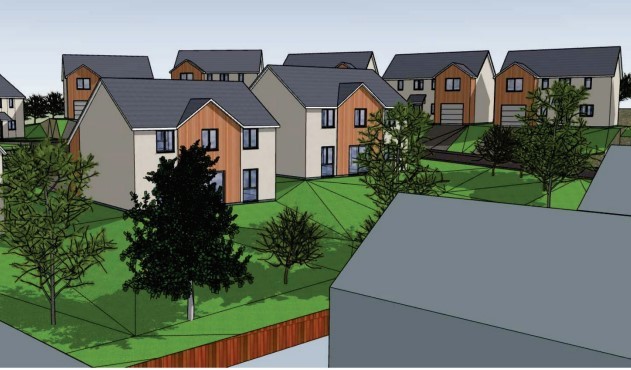
A planning proposal concerned the erection of 13 open market residential dwellings (Use Class C3) and associated work on the Uwch y Maes estate in Dolgellau.
The development would consist of a mix of two and three storey dwellings designed to mirror existing properties.
The planned road layout was in the form of a cul de-sac, “to respond to the existing topography of the site and to minimise impact on neighbouring properties at the site entrance”, a report said.
The scheme was approved at a meeting of the Eryri National Park Authority’s planning meeting, on Wednesday, October 10.
The site was described as having “a long and complex planning history” with outline planning permission to build on the site going back to 1972.
Applications for each phase of the larger estate development had been “determined on the understanding” of existent permission.
This meant there was no requirement for affordable housing contributions for recent applications.
The report noted: “It would be unreasonable to require the provision of affordable housing for this final development phase. It is therefore considered that the principle of the development is acceptable.”
The existing housing estate of 69 homes had been built on sloping ground, with each subsequent phase on higher ground.
Two letters sharing objections and concerns, had been received.
Issues included the number of properties to be built on the “small and elevated site” and it “not in accordance with the local development plan”.
It was also felt the two storey properties could have “a detrimental impact” on existing bungalows…with respect to visual dominance and loss of privacy”.
But planners had felt the development created “no substantial harmful impact”.
The housing would “make a positive contribution to the stock of open market dwellings” as C3 (residential permanent use) would “serve the local community,” director of planning and partnerships Keira Sweenie said.

Regarding numbers, a report had noted that the historical permission was for a total of 80 properties, with the larger site having permission for 94.
“The proposal for 13 dwellings, in addition to the 69 already built, would therefore sit comfortably within the number of dwellings historically permitted,” the planning report said.
The visual impact of the development from the wider landscape was also thought to be “minimal”.
It had been designed “to complement the existing topography of the site” and the development sought ” to minimise the impact on neighbouring properties as much as possible”.
The proposed design was “an improvement” to a previously consented scheme offering “a greater variation in design and use of materials” and would have “no adverse effect” on a nearby listed building.
Plas Y Brithdir, part of the Nannau Estate, was approximately 100m to the south.
It was thought the development could “offer improvements by “securing suitable landscaping” on boundaries.
The NRW had also suggested mitigation measures to protect the site of SAC (site of special conservation) including use of lighting which would not impact bats.
Councillor Ifor Glyn Lloyd said he would like to see more trees planted but was “glad to see use of local slate for roofs, whilst Naomi Luhde-Thompson would have liked “more information on the carbon standards” of the homes.
The recommendation was to grant planning permission subject to conditions, and following a vote, it was granted.