
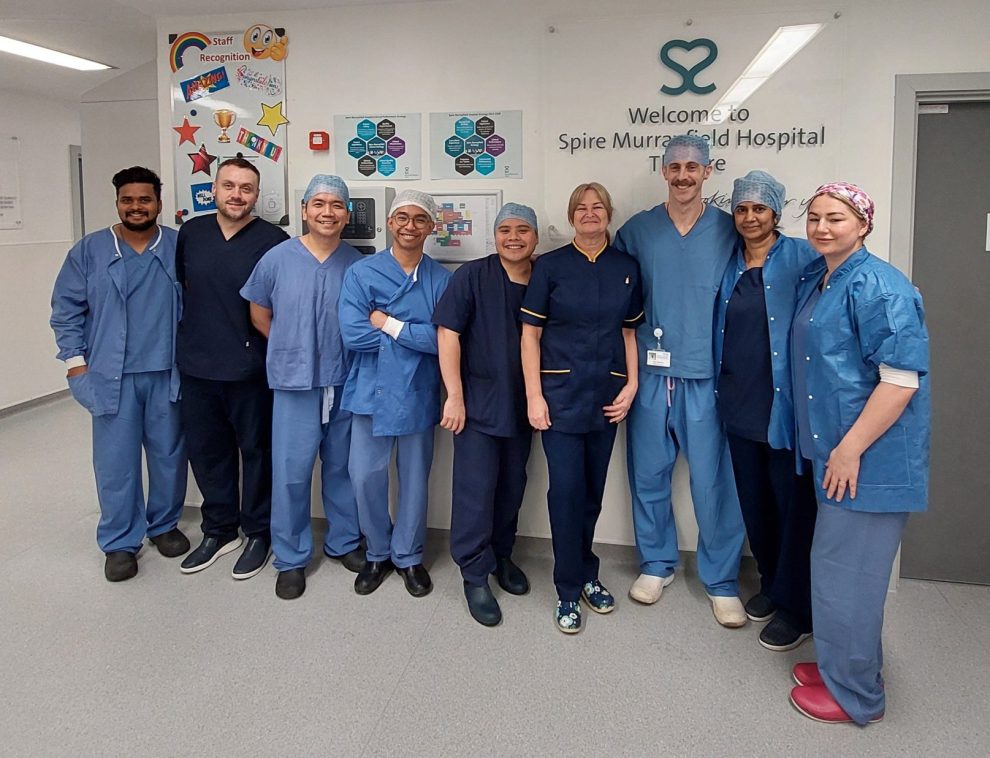

Landmark revision procedure performed using Pixee technology
A PRIVATE hospital in the North West has marked a national first after carrying out the UK’s first revision total knee replacement using augmented reality technology.
Spire Murrayfield Hospital Wirral confirmed that Consultant Hip and Knee Surgeon Mr Alan Highcock successfully performed the country’s first-ever revision total knee replacement (TKR) using Pixee augmented reality (AR) surgical guidance.
The milestone procedure is being described as a significant advancement in orthopaedic surgery and highlights growing use of digital innovation within operating theatres.
Augmented reality in the operating theatre
Pixee Medical’s augmented reality system is designed to enhance surgical precision and efficiency during knee replacement procedures. The technology provides surgeons with real-time visual guidance, supporting accurate alignment and optimal implant positioning throughout the operation.
Unlike some traditional computer-assisted or robotic knee surgery systems, which can require additional imaging, complex hardware or invasive reference points, the Pixee AR platform is compact and surgeon-controlled. It integrates into the operating theatre without adding significant complexity.

While the technology has been adopted internationally, this procedure marked its first use in the UK for a revision total knee replacement.
Supporting complex revision surgery
Revision knee replacements are considered among the most technically demanding orthopaedic procedures, often involving altered anatomy or previous implants.
Mr Highcock said precision was critical in such cases.
“Revision knee replacement surgery is among the most complex procedures we perform, and precision is absolutely critical,” he said.
“Being able to use augmented reality technology in real time allows us to visualise alignment and positioning with an unprecedented level of accuracy. To perform the UK’s first revision total knee replacement using Pixee AR is an exciting milestone, and one that ultimately supports better outcomes for patients undergoing challenging revision surgery.”
He added that augmented reality has the potential to reshape aspects of complex orthopaedic surgery by combining surgical expertise with real-time visual data to support decision-making during operations.
Spire Murrayfield Hospital Wirral said incorporating AR guidance could help improve alignment accuracy, support more personalised surgical decisions and reduce reliance on more invasive or resource-heavy navigation systems.
The hospital, part of the wider Spire Healthcare group, provides private hospital services across the North West, offering elective surgery and access to specialist consultants.
Hospital leaders say investment in next-generation technologies remains central to improving surgical outcomes and patient recovery.