



EFFICIENCY experts at Ailsa have revealed which parts of the country are searching for AI related terms like ChatGPT, Google AI, Claude, Gemini and Copilot the most.
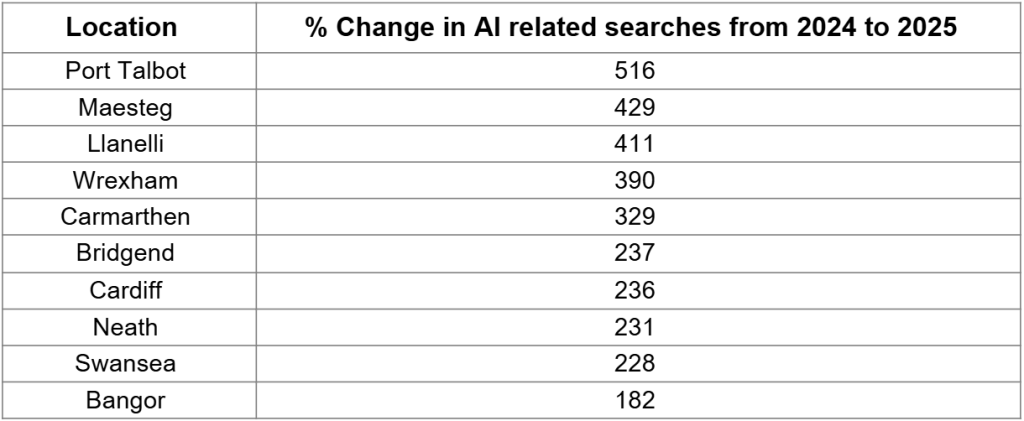
Whilst every part of the country has seen a sharp rise, Port Talbot led the way, searching for the terms around 36880 a month in 2024. In 2025 searches shot up to a monthly average of around 227270. That’s a table topping 516% surge. Maesteg came second with a 429% rise.
Llanelli, Wrexham, and Carmarthen rounded out the top 5 with 411%, 390% and 329% increases respectively.
Bridgend, Cardiff, Neath, Swansea, and Bangor saw the lowest % rises.
When we zoom out to the United Kingdom, there’s been a 233% uplift in searches for AI technology overall.

From a country level, Wales led the way with a 310% surge, followed by Northern Ireland with a 301% increase.
Scotland came third with a 233% rise, and England last with a 228% boost.

Kane Taylor, energy efficiency expert at Ailsa, said it’s encouraging to see people turning to AI, but fears it could have a big impact on the future of the planet.
Kane said: “AI is an incredible tool, it can save time, spark creativity, and make complex tasks effortless. But while it’s helping us work smarter, there’s also a hidden cost. Every query, every prompt, and every reply comes with an environmental footprint we can’t ignore.
“When these queries are sent on the likes of ChatGPT, it’s using up to 10x more energy than a browser search through Google, Edge or Chrome.
“Those questions that sometimes get asked can very easily just be put through a normal search engine and have much less impact on the environment.
“For example, just saying ‘thank you’ to ChatGPT will actually send another prompt and then another big pile of text off the back of it.
“That is also making an impact on the carbon footprint of said query. So not only is it taking up bandwidth on the network, but also on the energy side of things as well.
“So, we should ask ourselves, do we really need to query something in the first place, or say thank you, because it is just a robot at the end of the day.
“AI is very open at the moment, and anyone can do anything with it. I think some restrictions need to be put in place to reduce the carbon effects of queries but also limit the number of things that are getting asked several times in a row.

“So perhaps fine-tuning if a question’s already been asked, does it need to do all the calculations and all the searches if it’s already asked for that question before? There might be a better way from their side to automate an answer that’s already been generated previously.
“That could be done through reviews – ‘how helpful was this answer?’ – and if there was a particular one that had a high positive rate coming back, send that to the next user instead of recalculating everything again.”