

A TEACHER from Port Talbot has been lauded in a new report from the Royal Society of Chemistry (RSC), for going above and beyond by embedding real-world and locally relevant examples in his teaching.
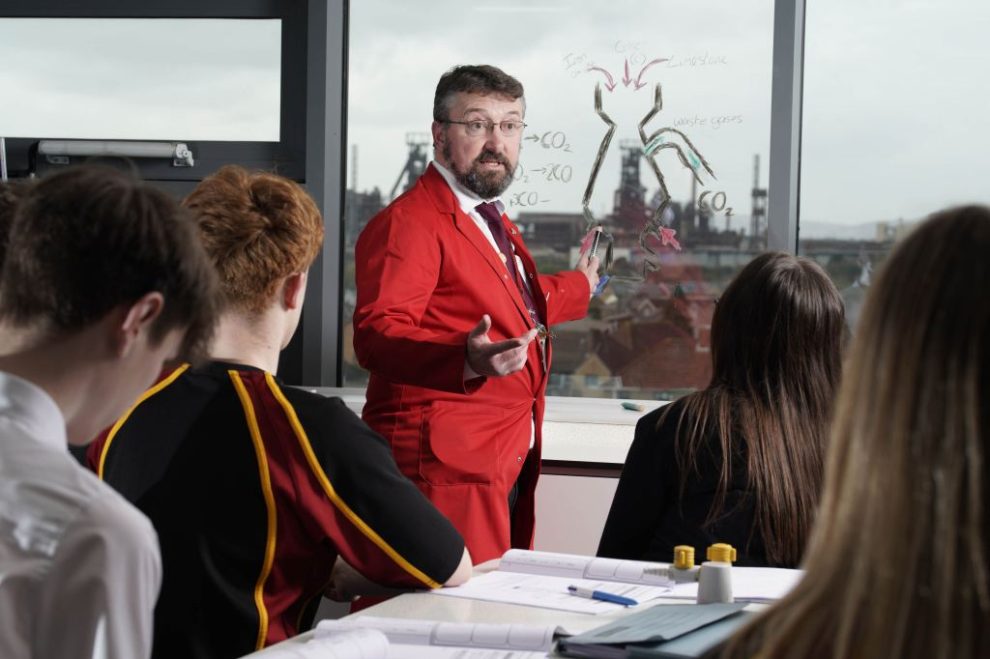
Eurig Thomas, Deputy Head Teacher at Ysgol Cwm Brombil high school in Port Talbot, drives engagement in chemistry lessons by using the silhouettes of South Wales’ last two blast furnaces, which are visible from the school, to encourage discussions on the impact of the steelworks industry.
With his classroom overlooking the retired infrastructure, Eurig directly labels their silhouettes on the window, using it as a visual aid to explore the chemistry of carbon emissions and the decision to close them.
In new research carried out by the RSC, just half of young people said they were taught sustainability topics in chemistry through contexts that are relevant to them. The findings are included in an RSC report launched today, Green shoots 3 – How to integrate sustainability and climate change into chemistry education.
Reflecting on the impact of his teaching methods, Eurig said: “These real-life examples turn abstract GCSE concepts into meaningful discussion. Students become more engaged and confident when they see science in action around them.

“Across our department, colleagues value how local contexts spark curiosity, deepen understanding, and foster pride in how chemistry shapes the future of our own community.”
Chemistry plays a critical role in addressing sustainability challenges, with demand for green skills eight times higher in chemistry-related roles than in the wider UK workforce. The RSC warns we need to engage young people in chemistry lessons through real-life examples they can relate to, in order to inspire a new generation of pioneering chemists.
Linking topics on sustainability in chemistry lessons to real-life contexts relevant to the students improves engagement and understanding. But experts suggest that unless contexts are included as part of exams, they may not be prioritised in teaching, as teachers are already grappling with heavy workloads and time constraints.
To bridge the gap between curriculum and real-world chemistry, the first step the RSC is calling for UK governments to take action on is to ensure contemporary sustainability and climate change content is included throughout national chemistry curriculums and assessments.
Annette Farrell, Education Policy Programme Manager at the Royal Society of Chemistry, said: “The role of the chemical sciences in addressing some of the most pressing sustainability challenges today cannot be overstated.
“Chemistry is at the heart of everything from the development of new green technologies to pollution prevention and the design of recyclable, biodegradable and reusable materials.
“Yet our report shows there is work to be done to improve young people’s understanding of how chemistry can shape sustainability in practice.
“We need to make sure our chemistry teachers have the time and autonomy to link the chemistry curriculum to local, national and global real-life contexts their students can relate to, in order to ensure the UK has a strong pipeline of talent for the years to come.”
Other asks in the Royal Society of Chemistry’s report include for governments to take a coordinated, holistic approach to embedding climate change, sustainability and the environmental impact of practical chemistry across national curricula, giving students a clearer and more connected understanding of how chemistry relates to global challenges.
They are further calling for exam boards to strengthen these links by making conceptual connections explicit and integrating environmental evaluation into assessments, ensuring sustainability becomes a core part of scientific learning and practice.

To read the report, and find out more about the RSC, visit: Green shoots 3 – How to integrate sustainability and climate change into chemistry education.