


SOUTH WALES witnessed a 67% rise in battery fires in the three years to March 2025, newly uncovered data has shown, largely down to an increasing number of vehicle fires.
Batteries are now a firm part of our everyday life, with lithium ion batteries now found in products such as phones, laptops, batteries and vapes. Larger batteries can also be found in cars and other every day electrical products now too.
When used and handled correctly, these batteries pose minimal risk. However, they can present a fire hazard if over-charged, short-circuited, submerged in water or damaged. Sometimes, this is also random.
Personal Injury Claims UK has gathered data from freedom of information requests sent to fire services across England and Wales. While fires are recorded differently by every force, so it’s hard to draw too many comparisons, and some don’t record the ignition source at all, the vast majority have reported a large rise in fires caused by batteries.
South Wales Fire & Rescue Service, one of the first to respond, revealed to Personal Injury Claims UK that there were 43 fires in 2022/23 which listed batteries, generators or battery chargers as the ignition source.

This rose to 63 the following year and 72 in 2024/25, representing a 67% jump in fire incidents over this time.
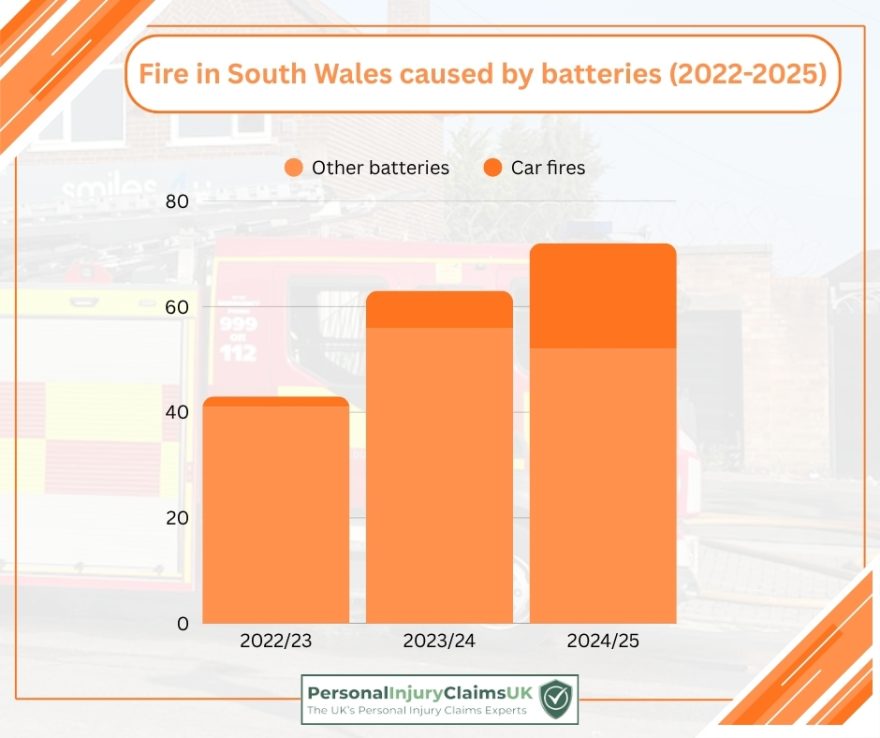
It means there have been 178 fires ignited by batteries during this time. Fatalities and injuries were joined together in the data, There were eight injuries and/or fatalities in 2023/24 and one the following year. There weren’t any in 2022/23.
The data also shows that a large part of the rise can be attributed to an increasing number of vehicle fires.
In 2022/23, there were only two battery fires involving road vehicles, representing 4% of the total. By 2024/25, this had shot up to 21, representing 29% of the total fires.
In terms of types of buildings, over the course of the three years, around a third of these incidents have taken place in ‘dwellings’.
A further 37% have taken place in non-residential buildings such as warehouses and shops and just under 20% have been cars. The remaining fires occurred on off road vehicles, ‘other residential buildings’ such as hotels and outdoor machinery and structures. ‘Significant rise’
Patrick Mallon from Personal Injury Claims UK said: “We’ve seen a significant rise in battery fires in recent years across England and Wales, reflecting the growing presence of batteries in everyday life.
“From household devices to electric vehicles, it’s vital that people understand the potential risks and handle batteries with care.
“These fires have the potential to cause really serious injuries, so it’s important everyone is fully aware of how to use these batteries safely and manufacturers and workplaces are aware of their responsibilities to consumers, too.
“If you suffer an injury through no fault of your own, however, you could hold the manufacturer to account by pursuing a compensation claim.”

Personal Injury Claims UK helps connect individuals with personal injury claim specialists with experience in cases involving defective products and faulty batteries
Their 24/7 phone service and live chat feature are both free to use.