

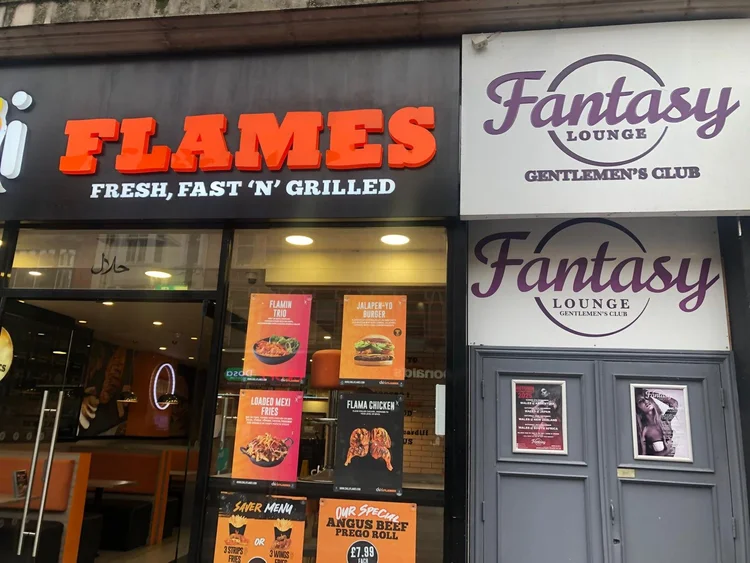

NEW RESEARCH research released from UK women’s right’s charity FiLiA reveals women want strip clubs closed. They say the clubs are harmful and exploitative, and they feel unsafe around them. Campaigners say these findings expose the gap between public experience and local authority licensing decisions.
The findings are presented in a new report, ‘Life near Strip Clubs: Women’s Voices from UK Cities’, launched in Parliament on June 2 to coincide with the start of a country-wide campaign, ‘No More Strip Clubs’, to empower and equip women to take action.
The report draws on research involving over 700 women in Cardiff, Edinburgh and Manchester. It details the day-to-day measures women build into their lives to avoid strip clubs, which are licensed by councils as “sexual entertainment venues” (SEVs).
Findings include:
- A majority (55%) of women surveyed near strip clubs oppose them, while just 8% are supportive.
- In Cardiff, local women reported that they feel ‘unsafe’, ‘vulnerable’ and ‘uncomfortable’ around the strip clubs because of the male customers. To manage risk they ‘avoid the area’ or ‘always walk with friends or family at night’.
- Young women in Cardiff said that growing up with three strip clubs concentrated along a single busy city-centre street made the sex trade seem like a normal ‘fallback’ option, particularly for girls from working-class communities. At so many points was I so close to falling victim, said one participant.
- Women linked strip clubs to the promotion of harmful attitudes towards women among men. One survivor of domestic abuse described how her partner’s fixation on local strip clubs and pornography escalated into serious violence, including strangulation. Still living near the Cardiff venues, she said: ‘I can’t escape it.
- Local women also described a disproportionate number of single mothers working in Cardiff’s strip clubs, linking this to financial hardship and limited alternatives.
Dr Laura Favaro, the report’s author, said: “The findings show that the impacts of strip clubs extend far beyond the venues themselves. They create environments in which women feel unsafe, restricted and devalued. The research demonstrates that these are not isolated experiences, but recur across UK cities.”

The report concludes that the continued licensing of strip clubs cannot be reconciled with councils’ equality duties or with wider commitments to tackling male violence against women. It calls for support and alternative pathways for the women working in strip clubs alongside the closure of them.
FiLiA’s new campaign, No More Strip Clubs, will include a Campaigner’s Toolkit to help women object to strip club licensing in their local areas.
FiLiA CEO Lisa-Marie Taylor said: “This research raises uncomfortable questions about local authorities’ licensing failures and neglect of their equality duties, exposing the gap between what the law says and what women actually experience on the ground.
“The Government’s 2025 Violence Against Women and Girls (VAWG) Action Plan committed to reviewing the SEV licensing regime – but only to close loopholes about which premises need a licence, not to question whether they should be licensed at all.
“This research makes that bigger conversation unavoidable.”
The research and campaign were launched in Parliament at a roundtable hosted by Jess Asato MP, who said: “The Government is committed to halving violence against women and girls and this report highlights how strip clubs are part of the landscape of commercial sexual exploitation that need to be tackled.
“FiLiA’s new research and campaign gives women whose experiences of strip clubs are often sidelined a voice in challenging harmful sexual entertainment licensing and I urge councils to listen to the women in their communities.”