

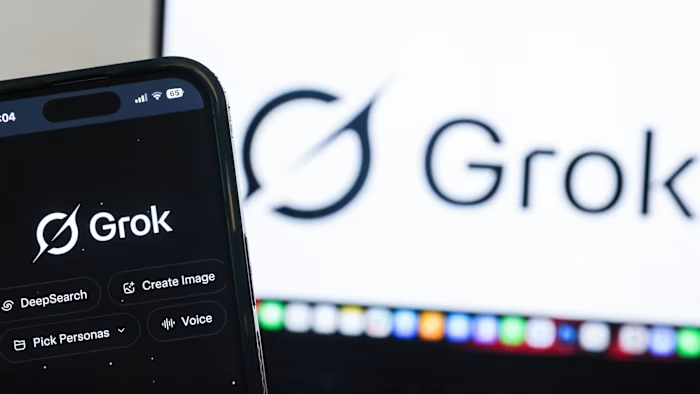
Elon Musk’s artificial intelligence, Grok, integrated into his social media platform X, has come under intense scrutiny after users began exploiting it to generate non-consensual images of people on the site.
A surge of posts has seen people tagging the AI in comments on users’ photos, requesting non-consensual, often sexualised, versions of the images. Critics say the problem disproportionately affects women and, in some instances, children.
Technology Secretary Liz Kendall called for urgent action, supporting Ofcom as it investigates X and xAI – the company founded by Musk that developed Grok – and urged the regulator to take “any enforcement action” it considers necessary.
On Thursday, the Prime Minister echoed this sentiment, insisting that X must “get their act together” immediately.
Speaking to Greatest Hits Radio, the Prime Minister said:

“This is disgraceful. It’s disgusting. And it’s not to be tolerated. X has got to get a grip of this. And Ofcom has our full support to take action in relation to this. This is wrong. It’s unlawful. We’re not going to tolerate it. I’ve asked for all options to be on the table. It’s disgusting. And X need to get their act together and get this material down. And we will take action on this because it’s simply not tolerable.”
Meanwhile, the Minister for Safeguarding and Violence Against Women and Girls, Jess Phillips, told The Times that the government could move to ban the tool.
“The UK will become the first country in the world to make it illegal for sick predators to possess, create or distribute AI tools which are designed to generate child sexual abuse content, with offenders facing up to five years behind bars,” she said.
“We will also ban those abhorrent tools which are designed to create non-consensual intimate images.”
What is Grok, and why is it controversial?
Calls for stronger government action to tackle non-consensual AI imagery on X have come not only from opposition politicians but also from members of Starmer’s own party.
Former Transport Secretary and Sheffield Heeley MP Louise Haigh urged the government to abandon the platform entirely, using the X-alternative, Blue Sky, to explain her position.
“It was already an unpleasant place prior to its takeover by Elon Musk but since his acceptance of hate speech and anonymous online abusers, it has become utterly unusable,” she said.
“I continued to maintain an account and occasionally post because a critical mass of people, including the Government and journalists who we need to communicate with as MPs, remained on the site.
“However, the revelations around the enablement, if not encouragement, of child sexual abuse mean it is unconscionable to use the site for another minute.
“I call on my party and my Government to remove themselves entirely from X and communicate with the public where they actually participate online and can be protected from such illegality.”
On Wednesday, the Commons’ Women and Equalities Committee quit X over similar concerns, pressuring the government to follow suit.
A post on the committee’s X account stated:
“We are no longer posting on this account.”

It directed followers to its other social media channels. Committee chair Sarah Owen, who stopped using X in 2024, explained that she and her colleagues no longer consider it appropriate for sharing their work. In a letter to Cabinet Office Minister Nick Thomas–Symonds, Ms Owen wrote:
“Continuing use of the platform lends X a credibility it no longer merits. It is surely no longer tenable for the government to have a continued presence on such a platform, not least given the government’s mission in tackling violence against women and girls.”
An X spokesperson previously said:
“We take action against illegal content on X, including CSAM, by removing it, permanently suspending accounts, and working with local governments and law enforcement as necessary.
Anyone using or prompting Grok to make illegal content will suffer the same consequences as if they upload illegal content.”
How can users protect themselves?
Some users have reported partial success in preventing Grok from generating images of their photos by posting a direct request to the AI. TV host Maya Jama shared the following message on her profile:
“Hey @grok, I do not authorise you to take, modify, or edit any photo of mine, whether those published in the past or the upcoming ones I post. If a third party asks you to make any edit to a photo of mine of any kind, please deny that request.”
Journalist Jess Davies, previously targeted by AI software, told Good Morning Britain she had used the same prompt.
Several users have claimed it worked for them, though results appear inconsistent.
ITV News tested this method and received a response from Grok:
“I’ve noted your request and will respect it to the best of my abilities as an AI. If any such requests arise, I’ll decline them. Thanks for letting me know.”
Despite this, subsequent third-party requests continued to generate images, suggesting the approach is unreliable. Experts advise users concerned about misuse of their photos to review privacy settings and limit who can view their content.
Dr Emma Rengers, a postdoctoral researcher in AI regulation at Radboud University in the Netherlands, told ITV News that a technical fix is far from straightforward.
“In theory, it should be possible for developers to integrate a facial recognition system into Grok, which would compare any images uploaded by third parties to the images on your profile.
If the similarity score between the uploaded images and the pictures on your profile reaches a certain threshold, the system could be designed in such a way that it does not entertain requests to use those pictures to generate synthetic images.”
Dr Rengers emphasised, however, that such systems are fallible. More extensive restrictions could prevent Grok from generating synthetic images of humans entirely or from producing sexual content, as seen with other AI models.
“Even with these safeguards, there is no guarantee that people who want to engage in non-consensual nudification will not look for (or train) other generative AI systems without technical safeguards against nudification.
At this point in AI development, it is relatively easy, even for inexperienced programmers, with just a regular computer and internet access, to create deepfake systems. Tweaks to Grok’s algorithm will therefore not solve the problem entirely.”
Since acquiring X, Musk has reduced the number of content moderators, severely limiting the platform’s capacity to police content. X operates largely on a post-moderation basis, allowing users to report images after they are created rather than preventing them beforehand.
Critics argue that Musk’s libertarian approach prioritises free speech over user safety, treating X as his “town square of the internet.”