

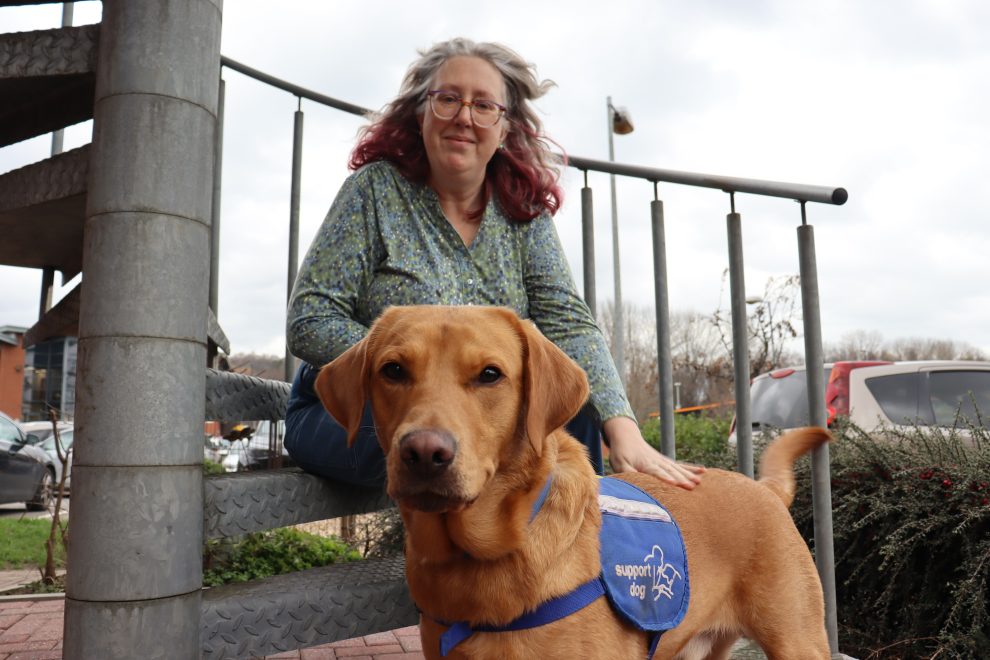

EMMA REARDON was an active mum, while studying and working, despite having the life-long condition of Ehlers-Danlos Syndrome, a disorder of the connective tissues.
But during the pandemic, she was struck down with long Covid, and later diagnosed with heart failure.
The triple whammy knocked Emma, who sometimes uses a wheelchair or mobility scooter, for six.
But after getting her pet Red Fox Labrador, Jeff, trained as a disability assistance dog by the national Support Dogs charity, the 53-year-old says she feels like she’s living again.
“My illness zapped me of my confidence and stopped me in my tracks,” said Emma, a former social care manager who now works as director of a non-profit autism organisation.

“I went from being someone who was full-time employed and a full-time mum to someone who’s now working part time because of my health.
“A combination of all these conditions meant I couldn’t live the life-style I had before.”
The mum-of-one, from Carmarthen, had dogs in the past and she got Jeff as a six-month-old pup to feel less isolated.
“He did start getting me out, and I realised how much he loved to work,” said Emma.
“I saw a Support Dogs advert on social media and applied to the charity in late 2024.”
Following interviews, assessments and obtaining of medical records, Jeff spent a month at Support Dogs’ training centre, being looked after by volunteer doggy foster carers on evenings and weekends.
Emma then joined him, spending two weeks learning handler skills and then the pair spent the following nine months putting everything they’d learned from Support Dogs into practice back home in Wales.
Jeff has been trained to act as a personal carer for Emma, supporting her 24/7. He accompanies her to work and hospital appointments and has been trained to support her with a wide range of day-to-day tasks. This includes opening doors and pressing access buttons, which particularly helps Emma when she’s using her wheelchair or mobility scooter.
He can also pick up and fetch items like Emma’s mobile phone.
“He also picks things up I drop, because bending over is difficult for me and he helps me on and off with my jacket and my socks and gloves,” said Emma.

She added that as well as practically, Jeff also helps signal to people that she has a disability, and that attention is now on Jeff, rather than her.
“Those are the tasks he’s trained in, but more than that, just having him with me means when I go out I just feel more confident,” said Emma.
“It’s two-fold – I could look like I’m fine when I’m not fine.
“Sometimes people assume I’m Jeff’s trainer, because my disability isn’t visible, so having Jeff means people do recognise that I might need a bit of space, or a bit of help.”
She described having Jeff trained by Support Dogs as “life-changing” and added: “It’s got me out and about. It’s got me taking part in life much more and feeling much less defined by my illness or disability.
“Having Jeff, it’s about what I can do now, whereas before, it was about lots of things I found I couldn’t do.
“I can’t thank Support Dogs enough.”
Support Dogs trains and provides specialist assistance dogs to help autistic children, as well as those with epilepsy or a physical condition, to live safer, more independent lives.
It provides its services free of charge and relies entirely on voluntary donations.
To learn more, please visit www.supportdogs.org.uk or call 0114 2617800.