


European leaders have closed ranks in support of Denmark and Greenland after a senior aide to Donald Trump suggested the United States could be prepared to take control of the Arctic territory by force.
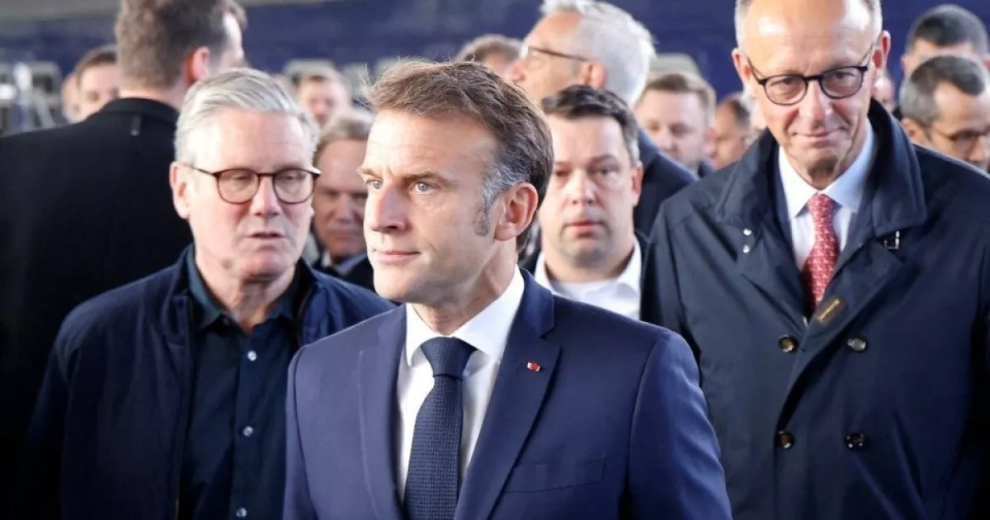
Sir Keir Starmer, the UK prime minister, Emmanuel Macron of France and Germany’s chancellor, Friedrich Merz, issued a rare joint rebuke to the White House, declaring that Greenland – a semi-autonomous territory within the Kingdom of Denmark – “belongs to its people”.
“It is for Denmark and Greenland, and them only, to decide on matters concerning Denmark and Greenland,” the three leaders said in a statement released on Tuesday alongside the prime ministers of Denmark, Italy, Poland and Spain.
Later that evening, speaking at a press conference in Paris attended by Trump’s special envoy Steve Witkoff and his son-in-law Jared Kushner, Sir Keir reiterated Britain’s backing for Copenhagen. “I’ve been very clear as to what my position, the position of the UK government, is,” he said.
However, wary of deepening an already fragile transatlantic relationship, the European leaders sought to shift the focus to renewed security commitments for Ukraine at a summit planned before the Greenland row erupted.

The intervention followed a sharp escalation in rhetoric from Washington. On Monday night, Stephen Miller, the US president’s influential deputy chief of staff for policy, suggested that no country would challenge American control of Greenland, saying “nobody is going to fight the United States militarily over the future of Greenland”.
In an interview with CNN, Miller argued that military action would not be necessary because of Greenland’s small population. A day earlier, Trump had again insisted that the US needed Greenland “very badly”, reviving fears of an attempted takeover driven by strategic and economic interests as melting ice opens access to oil, gas and rare earth minerals.
The comments caused alarm in Denmark. Prime Minister Mette Frederiksen warned that any attack on Greenland would risk the collapse of Nato, describing it as the end of “everything”.
A flurry of diplomacy followed, culminating in Tuesday’s European statement ahead of the Paris summit on Ukraine’s security guarantees. Leaders stressed that Arctic security must be addressed collectively through Nato, not by one member seizing the territory of another.
“Nato has made clear that the Arctic region is a priority and European allies are stepping up,” the statement said. “We and many other allies have increased our presence, activities and investments to keep the Arctic safe and to deter adversaries.”
Denmark and Greenland have requested an urgent meeting with US secretary of state Marco Rubio to “discuss the significant statement made by the United States about Greenland”, according to Greenland’s foreign minister, Vivian Motzfeldt.
Lord Ricketts, the former UK national security adviser, warned that any US annexation of Greenland would be disastrous for Nato, amounting to “for all practical purposes, the end of an alliance which is based essentially on trust”.
In such a scenario, he said, looser security arrangements – such as the UK- and France-led coalition supporting Ukraine – would take on far greater importance, alongside bilateral defence ties with Washington.
Despite attempts by some US officials to row back, the White House confirmed on Tuesday night that Trump and his advisers were actively discussing ways of acquiring Greenland, with military force “always an option”.
“President Trump has made it well known that acquiring Greenland is a national security priority of the United States,” the White House said in a statement to Reuters. “The president and his team are discussing a range of options to pursue this important foreign policy goal, and of course utilising the US military is always an option at the commander-in-chief’s disposal.”

Earlier, Miller had questioned Denmark’s right to the territory, describing Greenland – inaccurately – as having a population of 30,000 rather than its actual 57,000.
“What do you mean, military action against Greenland?” he said. “Greenland has a population of 30,000 people. The real question is what right does Denmark have to assert control over Greenland?”
He added that there was “no need to even think or talk about” a military operation, insisting: “Nobody is going to fight the US militarily over the future of Greenland.”
The interview came shortly after Miller’s wife, the rightwing podcaster Katie Miller, posted an image on X of Greenland overlaid with a US flag and the caption “SOON”.
Later on Tuesday, however, the Wall Street Journal quoted Marco Rubio as playing down the prospect of military action, saying Trump still hoped to buy Greenland.
In Greenland itself, the reaction has been one of anger and anxiety. Naaja H Nathanielsen, the minister for business, mineral resources, energy, justice and gender equality, said: “The people of Greenland take this potential threat very hard and are anxious and afraid.”
While Greenland had long been “a good American ally”, she said, that did not equate to “acceptance of – or interest in – becoming Americans”.
“We are very few, but we are a people in our own right and insist that we are the ones to decide the future of Greenland,” she added.
The island’s prime minister, Jens-Frederik Nielsen, went further, urging Trump to abandon his “fantasies about annexation” and condemning US rhetoric as “completely and utterly unacceptable”. “Enough is enough,” he said.
Inuit peoples have lived in Greenland since around 2500 BCE. Danish colonisation began in 1721 and the island remained a colony until 1953, when it became part of the Danish kingdom. During the second world war, Greenland was occupied by US forces after Denmark fell to Nazi Germany, before being returned in 1945. The US has maintained a key military base at Pituffik – formerly Thule – since the cold war.
Support for full independence has grown in recent years, particularly following revelations about Denmark’s treatment of Greenlanders during and after colonial rule, including the IUD scandal.
Against the backdrop of Trump’s renewed threats, Greenland formed a four-party coalition government in March in a show of unity. The opening line of its coalition agreement was unequivocal: “Greenland belongs to us.”