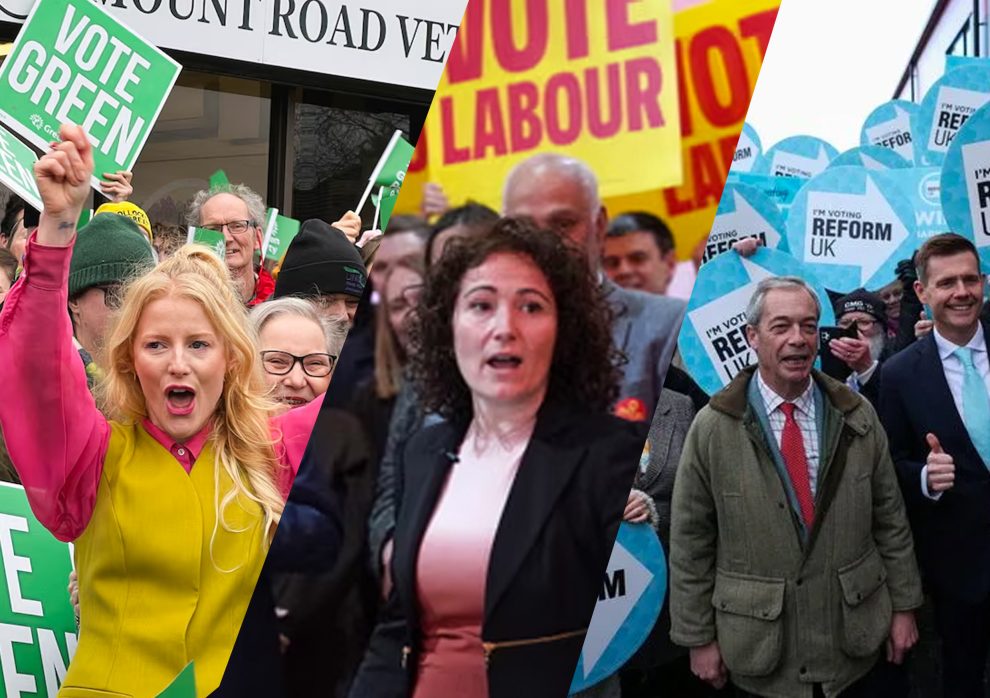

VOTERS in south-east Manchester have gone to the polls in one of the most unpredictable byelections in recent years, with the Green Party, Labour and Reform UK locked in a tight three-way contest.
Green Party leader Zack Polanski described the race as “neck and neck” with Reform UK, saying Labour’s 13,000-vote majority could be overturned. He added that the party would expect Labour to “search their conscience” if Reform were to triumph.
Labour has sought to appeal to left-leaning voters in the Greater Manchester constituency, warning that a vote for the Greens would effectively hand victory to Nigel Farage’s Reform UK. The strategy echoes the party’s approach in the Caerphilly byelection last October, which Labour lost to Plaid Cymru despite repeatedly urging voters that only it could defeat Reform.
Speaking before polls opened at 7am on Thursday, Polanski accused Labour of deliberately attempting to split the left-wing vote, arguing that a Green win would be “existential” for Keir Starmer.
“It’s looking neck and neck between the Green Party and Reform,” he said. “I don’t think Labour are in this race at all – they’ve known that for a long time.”

Although Polanski grew up in Manchester, he chose not to stand in the constituency. He said internal party data suggested the Greens were narrowly behind Reform, with Labour “way, way behind”.
“The Labour Party know the Green Party is on track to win this election, and I think they’re doing everything they can to split the vote,” he said. “My biggest fear is that Reform could win by just a handful of votes because Labour took a small but decisive share of the vote.”
A split on the left enabled Reform to claim victory in the Runcorn and Helsby byelection last May by six votes.
Labour is defending a 13,413-vote majority in Gorton and Denton, where nearly 80% of voters backed a left-leaning party at the 2024 general election. The result is expected to be declared at around 4am on Friday.
Angeliki Stogia, a Labour councillor, was selected as Starmer’s candidate after Andy Burnham was prevented from standing. Reform UK’s candidate is Matt Goodwin, an academic and GB News presenter who has faced criticism for his remarks on women, Muslims and British citizenship. Hannah Spencer, a Trafford councillor and plumber by trade, is standing for the Green Party.
Professor Will Jennings of the University of Southampton described the contest as “too close to call” in Britain’s increasingly fragmented political landscape. He warned that a Labour defeat would be “terminal” for No 10’s strategy of appealing to right-leaning voters at the risk of alienating core progressive supporters.
“It would be a symbol of the failure of that strategy and its endpoint,” he said. “The worst-case scenario for Labour is coming third behind Reform and the Greens, particularly after the decision to block Andy Burnham from standing.”
A Labour win, by contrast, would signal a potential turning point, offering some respite for a government currently trailing Reform by eight points in the polls and facing a resurgent Green Party. Any relief, however, is expected to be short-lived, as Labour is widely predicted to suffer significant losses in the local and devolved elections across England, Scotland and Wales in ten weeks’ time.
During a visit to the constituency on Monday, Starmer described the Greens’ plan to legalise drugs as “disgusting”, claiming it would turn parks and playgrounds into “crack dens”. Polanski accused the Labour leader of engaging in “spoiler behaviour”, suggesting overconfidence in a contest the Greens see as highly competitive.
Polanski also criticised a Labour attack advert shared on social media, which depicted a green syringe alongside the words: “Heroin, crack cocaine, spice. Green Party says YES.”

“It’s the last desperate gasp of a Keir Starmer Labour government,” he said.
The byelection was triggered by the resignation of Andrew Gwynne in January on health grounds. The former MP was under parliamentary investigation for offensive messages sent in a WhatsApp group of local Labour figures.
The outcome of the Gorton and Denton byelection could have far-reaching consequences beyond Greater Manchester. A Green victory would signal a growing appetite for alternative parties on the left and a potential weakening of Labour’s grip on traditional strongholds. It would embolden smaller parties and indicate that voters are willing to shift away from the two main parties, complicating Labour’s efforts to maintain a broad coalition under Starmer.
Conversely, a Reform UK win would underscore the appeal of right-leaning populist politics in urban areas, putting further pressure on both Labour and the Conservatives to recalibrate their strategies ahead of the local and devolved elections in ten weeks. Even a narrow Labour hold would be interpreted as a temporary reprieve, highlighting the party’s vulnerability and the fragility of its support base.
In short, the result will be closely scrutinised as a barometer of national political trends, offering insight into voter sentiment, party strategies, and the potential shape of future contests across England, Scotland and Wales.