
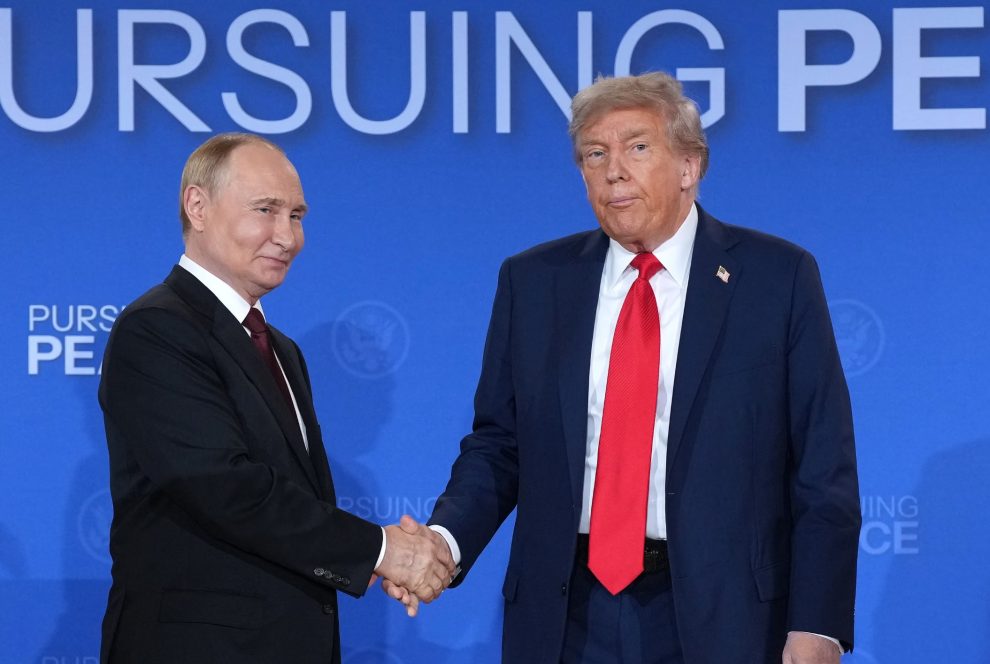

A HIGH-PROFILE summit between Donald Trump and Vladimir Putin in Anchorage, Alaska, has ended with both leaders hailing “progress” on Ukraine but offering no concrete details – and with the US president abruptly walking away from questions.
The meeting, held at Joint Base Elmendorf-Richardson, lasted around three hours and concluded earlier than planned. Expectations had been high for a breakthrough in the war that has raged since Russia’s full-scale invasion in 2022, but the day’s events left more questions than answers.
Vague promises, no specifics
Putin, speaking first at their joint press conference, said the pair had reached an “agreement” and warned that Kyiv should not “throw a wrench” into the process. He did not outline what the agreement contained, but repeated his longstanding line that the “root causes” of the conflict must be addressed – rhetoric that in the past has included false accusations about Ukraine’s government and justification for Moscow’s territorial claims.
Trump described the talks as “extremely productive,” insisting there was a “very good chance” of a deal, but adding: “There’s no deal until there’s a deal.” He said he would brief NATO and Ukrainian president Volodymyr Zelenskyy, but gave no timeline or detail on the remaining points of contention. He left the podium without taking any questions from reporters – an unusual move for a president known for lengthy, freewheeling exchanges with the press.
Red carpet optics spark backlash
The summit began with a carefully choreographed arrival. The two leaders met on a red carpet rolled out by US military personnel – a visual seized upon by Ukrainian commentators and political figures as a propaganda victory for Moscow.
Mustafa Nayyem, a Ukrainian journalist-turned-politician, posted the image with the caption: “Make Kneeling Great Again,” referencing US servicemen securing the carpet before Putin disembarked. Olga Rudenko, editor of the Kyiv Independent, said: “This is Putin’s new phone wallpaper.”
Russian state media, including the defence ministry-owned Zvezda channel, widely broadcast the footage. Kremlin spokeswoman Maria Zakharova mocked Western reports that Russia had been isolated, saying: “Today they saw the beautiful red carpet laid out for the Russian president in the US.”
The White House later posted edited footage of the greeting to social media, cutting out the moment Trump applauded Putin – which had been clearly visible on the official live stream.
Fighting continues during talks
In Kyiv, Zelenskyy noted that Russian missile and drone strikes on Ukrainian cities had continued during the summit. “On the day of negotiations, the Russians are killing as well. And that speaks volumes,” he said, listing attacks on Sumy, Dnipro, Zaporizhzhia, Kherson, and Donetsk. “Security guarantees are needed. Lasting peace is needed,” he added, urging a trilateral meeting involving Ukraine, the US, and Russia.
Symbolism of Alaska venue
The choice of Anchorage carried its own symbolic weight. Putin referenced the Russian Empire’s historic control of Alaska before it was sold to the US in 1867, pointing out Russian place names and Orthodox churches still present in the state. For many in Ukraine and Eastern Europe, such historical narratives are seen as part of a broader ideological framework – the so-called “Russian world” – that Moscow has used to justify territorial expansion.
Press access and global implications
The abrupt ending of the press conference without questions, coupled with the White House’s editing of official footage, has fuelled concerns about transparency. Press freedom advocates noted that the lack of scrutiny mirrored tactics seen in more authoritarian states, where public messaging is tightly managed to control the narrative.
Globally, the summit’s outcome – or lack thereof – is being watched not only for its implications in Ukraine but for what it signals about US-Russia relations under Trump’s presidency. While the former president has long boasted of his personal rapport with Putin, critics argue that such displays risk legitimising an indicted war criminal without securing tangible concessions.
No breakthrough – yet talks set to continue
Both sides signalled an intent to keep talking. “We really made some great progress,” Trump said. Putin said the two leaders would meet again, with the Russian president inviting Trump to Moscow.
For now, the world is left waiting to see whether the “progress” claimed in Alaska will translate into a lasting peace – or whether the summit will be remembered more for its theatre than for its substance.