
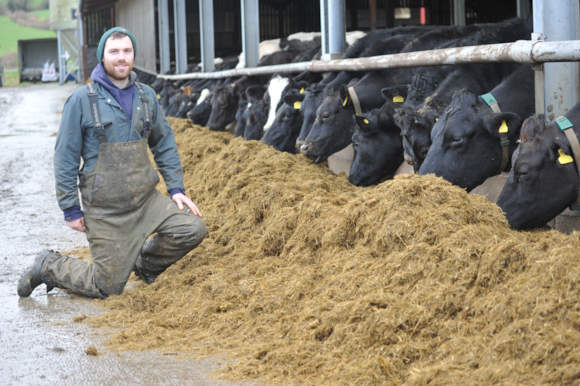

Targeted breeding decisions set to boost milk solids and fertility on Abergele dairy farm
GENOMIC testing of crossbred heifers and first lactation cows has revealed significant variation in fertility and milk solids potential at a North Wales dairy farm – providing valuable data to drive more targeted breeding decisions.
The Edwards family at Rhydeden, Abergele, screened 113 replacement heifers and younger cows as part of a Farming Connect Our Farms network project, with the aim of accelerating genetic gain within their split block-calving herd.
Until recently, genomic evaluation was largely confined to purebred dairy cattle. However, the technology is now available for crossbred animals too, offering more farmers the opportunity to make measurable genetic improvements.
Father and son, Alun and Eurof Edwards, who supply milk to South Caernarfon Creameries, say the results will directly influence breeding decisions in 2026.
Their milk contract is based on fat and protein content, so breeding for higher milk solids is a key focus.

The herd currently averages 5,900 litres per cow at 4.8% butterfat and 3.88% protein, producing 528kg of milk solids from 1.1 tonnes of concentrate per cow per year.
Wide variation uncovered
Across the 113 animals tested, protein percentages ranged from 0.04 to 0.36%, fat from -0.01 to 0.59%, and the female Fertility Index (FI) from 2.4 to 20.6. The scale of variation highlighted stark differences in performance potential between individual animals.
Third-generation farmer Eurof Edwards said the data would underpin breeding decisions from May 2026.
“Previously we would select blindly, especially with the heifers, just looking at parentage,” he explained. “Based on this new genomic data our breeding decisions this spring will be different – they will be far more targeted.
“We weren’t necessarily missing the very best animals before, but we were probably breeding from below-average heifers while overlooking some of our top 70 cows and 70 heifers.”
He believes more targeted breeding will improve herd efficiency and long-term profitability.
“It has been a straightforward way of collecting data on our cows. It will make it simpler to breed for improvement at very little cost compared to other investments, and with good effect too.”
Low replacement rate
The project used NMR’s GeneEze ear notch tissue testing, costing £25.50 per animal.
Rhydeden operates a closed herd system with 175 spring-calving and 125 autumn-calving cows, having transitioned from an all-year-round calving pattern. Up to 70 heifers are reared annually as replacements.
With an empty rate of just five per cent in 2025, the replacement rate is relatively low.

Historically, breeding policy focused on producing replacements from heifers and cows regarded as the ‘best’, using sexed semen. However, this was done without knowing whether those heifers genuinely had superior genetics to cows bred to beef sires.
“We assumed that because the heifers were from newer sires, they were better,” Eurof admitted. “But genomic testing has shown that’s not always the case.
“There was a big range. Some were poorer for milk, while others really impressed for fertility and milk solids. That didn’t surprise us – that’s the strength of the crossbred cow.”
Suited to hilly ground
Rhydeden extends to 149 hectares of owned and rented land. Its hilly terrain and the distance between grazing paddocks and the parlour make crossbred cows better suited than larger Holsteins.
“The cows have to walk quite a bit and most of it is uphill, so big Holsteins wouldn’t suit our system,” Eurof said.
Spring block calving begins on February 18, with cows turned out to graze as they calve and remaining at grass until late October. Autumn calving starts on September 10.
“Breeding is a slow process, so it has to be right,” Eurof added. “If we can breed a better cow producing more milk solids, then investing in genomic evaluation is a sensible approach.
“It’s an easy way to see what we’ve actually got. Every farmer can make better breeding decisions quite easily. We always use the best bulls, but we want to breed from our best cows too.”
Data-driven decisions
Farming Connect Dairy Sector Officer Osian Hughes, who led the project, said the genomic results will allow Rhydeden to compare heifer rankings with cow Profitable Lifetime Index (£PLI) figures calculated through milk recording.
This will help identify the highest genomic merit animals to breed to dairy sexed semen.
The herd’s average PLI currently stands at -85, reflecting comparisons of crossbred heifers with smaller capacity against the AHDB Holstein base.
“Milk yield, protein and fat kilograms were the most significant factors influencing PLI at Rhydeden,” Mr Hughes said.
The Edwards family intend to make full use of the data and are likely to continue genomic testing in future.
“Data can make us more efficient as farmers,” Eurof concluded. “But it’s only valuable if you use it. The key is deciding which data will genuinely improve your business.”