
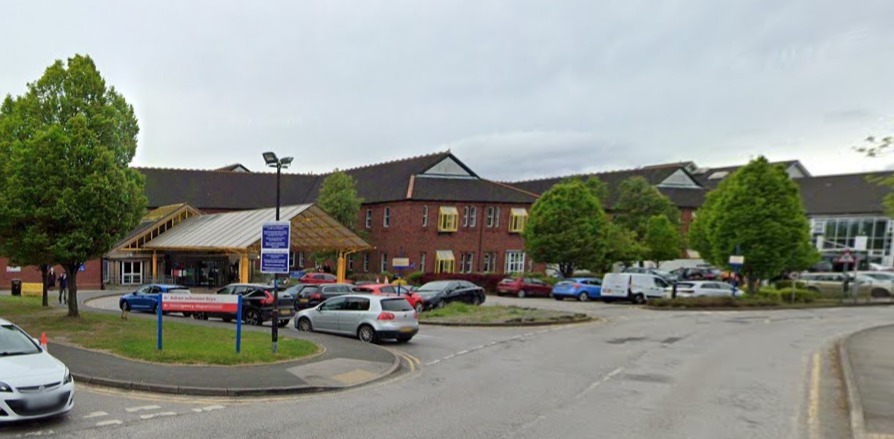

A WOMAN from Buckley says stretched staff, archaic systems and poor infrastructure at Wrexham Maelor meant her father – and other vulnerable older patients – are not receiving the care they need.
Jayne Economos said that a series of incidents involving her father – including the failure to communicate that he had a broken rib and keeping him sedated on a ward with another patient making noise that caused distress – highlighted the need for significant improvements.
She is now is calling on Wrexham Maelor and Betsi Cadwaladr University Health Board (BCUHB) to invest in modernisation, better staff training, more frontline workers and facilities which better meet the needs of patients.
Jayne – who is leaving her job in Australia to move home to help care for her father – says his condition deteriorated so much in hospital he is no longer able to live independently.
She praised the staff who she says did their best to care for him, but added that the resources and infrastructure around the hospital meant they were working in an impossible situation.

“He was found by a neighbour with low blood pressure at home,” she said. “One of the neighbours called an ambulance and he was taken to the Maelor where he was admitted to AMU after a day.
“He was doing okay for the first few days and when I got there they said there seemed to be no reason why he shouldn’t be going home.
“But then there was a series of very unfortunate events one after the other. He has dementia and is very independent. Initially he took his suitcase to the door and tried to leave.
“After that he started to be given a combination of antipsychotics and sedatives. My dad has lived on his own for maybe 40 years. He never takes anything for pain really.
“So that medication made his dementia presentation worse as he felt restrained.
“Then there was this poor gentleman in the bed directly opposite him who I believe had another kind of dementia. His caused a lot of yelling which, for my father and his dementia was really difficult to cope with.
“Without anywhere suitable to move this gentleman to however the staff could do nothing. When they finally were able to move him to another ward they moved my father with him.
“The whole thing was exacerbated by the fact that, due to the Maelor using paper notes rather than a digital system, they had somehow managed to miss the transfer of notes from one ward to another that indicated my father had broken ribs which was probably contributing to his delirium and pain.”
During his time in Wrexham Maelor his presentation got worse, with increased instances of psychosis and a greater reliance on individual support to use the bathroom as he was not kept mobile throughout his stay.
Jayne praised the staff for trying to help her father and other patients, but said their hands were tied.

“The staff are just incredible under very, very difficult circumstances,” she said. “But staffing levels and infrastructure are making it impossible for them.
“Transferring information on paper is archaic. If you go to the Countess of Chester, apparently they’ve been implementing digital patient records for a while but at Wrexham it’s chaotic. It’s not the staff, it’s the infrastructure.”
Jayne’s father has been discharged and is now being cared for at Bryn Hesket Unit in Colwyn Bay, which she says is much better suited to his needs.
“They’re doing an amazing job,” she said. “They’ve got a lot of staff. They’ve got a lot of space. He’s got access to an outdoor area and he is beginning to improve. He has lost much of his independence but I think his stay at Wrexham Maelor accelerated his decline.
“I just want to see change now so that patients and staff have the support and systems in place they need to get the best possible outcomes in future and other families don’t have to go through this.”
Dr Clara Day, BCUHB’s Executive Medical Director, said: “I want to apologise for the distress experienced by Mrs Economos and her family.
“Dementia can be a complex condition and we recognise how difficult an acute admission can be for those living with it. In these circumstances it is vital we fully communicate with family members.
“We are reviewing both our contact with the patient and our communication with Mrs Economos. As part of that process we will contact her to discuss the issues she has raised. It is essential that we learn from the experiences of patients and their families in order to ensure our care is at the highest level possible.”