

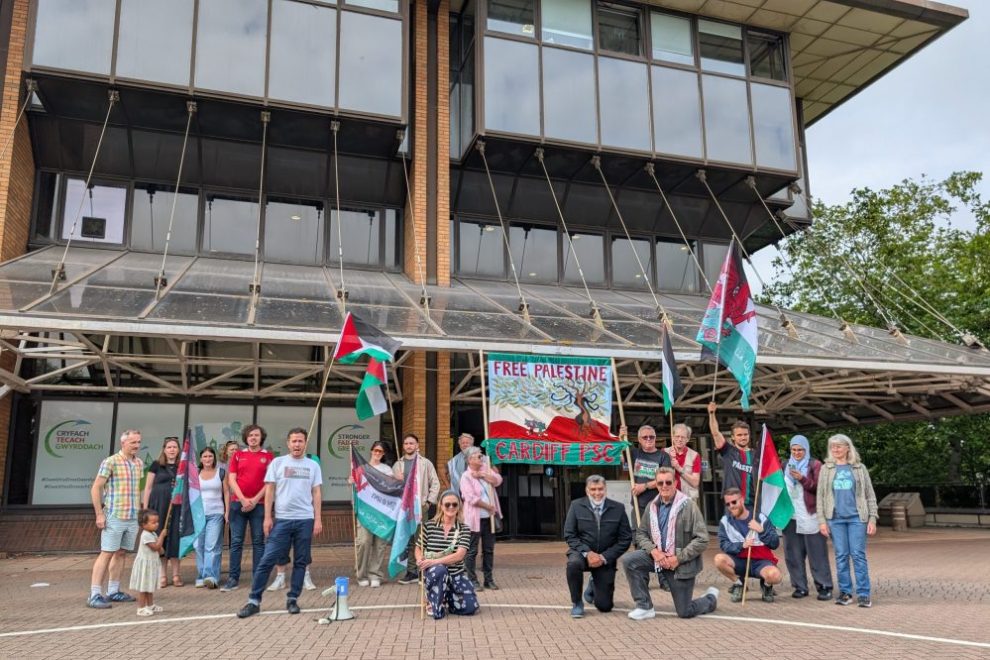

CARDIFF COUNCIL has passed a motion calling for the divestment of its pension fund from companies allegedly complicit in breaches of international law in Gaza, following a strong show of public support and a heated debate at City Hall.
The motion, passed by 57 votes to four, follows the submission of a petition signed by 1,200 Cardiff residents, demanding that the council stop investing in firms accused of facilitating what campaigners describe as Israel’s genocide and apartheid policies towards Palestinians. The petition was jointly backed by the Cardiff Palestine Solidarity Campaign (PSC) and the Muslim Council of Wales.
The proposal was brought by Cllr Andrea Gibson (Plaid Cymru, Pentyrch and St Fagans), who said the council’s move reflects a growing public desire for ethical investment and international accountability.
“Cardiff has an opportunity to lead Wales by becoming the first local authority to take a stand on this issue,” she said. “This is a practical step towards more ethical public policy and shows solidarity with Palestinians suffering in Gaza.”
Motion outlines concerns over war crimes
The approved motion notes that the ongoing conflict in Gaza has resulted in a “significant loss of innocent life” and expresses a belief that public sector pension funds should not invest in companies linked to war crimes, human rights violations, or the breaking of international law, regardless of profit.

The Council resolved that it “does not wish to be associated with companies potentially complicit in war crimes.”
According to the Cardiff PSC, the city’s pension fund currently holds £117 million—around 3.7% of its total pot—in 52 companies they allege are linked to violations of international law, including the construction of illegal settlements and military activity in the Occupied Palestinian Territories.
List of ‘complicit’ companies named
The PSC’s research includes investments in:
- £4.9m in four Israeli banks (Leumi, Hapoalim, Mizrahi Tefahot Bank and Israeli Discount Bank), which finance illegal settlements.
- £2.3m in Israeli real estate operating on Palestinian land.
- £5.5m in Barclays, which raises funds for weapons manufacturers.
- £1.1m in Palantir, partnered with the Israeli Ministry of Defence.
- £29m in Alphabet (Google’s parent company), which co-develops cloud computing for Israel’s military.
- £3m in BAE Systems, which supplies components for weapons used by the IDF.
The PSC says the full divestment of these companies is financially viable and has offered its findings to the council’s Pension Fund Committee to support implementation.
Councillors express strong views
During the debate, Labour councillor Dan De’Ath described the Gaza conflict as “an abomination,” comparing the global reaction to South African apartheid in the 1980s. Cllr Imran Latif warned that the horrors in Gaza are “beyond comprehension,” citing the International Court of Justice’s statement that the situation may constitute genocide.
Independent Cllr Emma Reid Jones said the Council’s focus “remains firmly centred on Gaza,” while Labour’s Ali Ahmed spoke emotionally of children being bombed while queuing for water, saying: “If this keeps going, no one will be left in Gaza.”
However, there was opposition from the Conservative group. Cllr Calum Davies argued that the Boycott, Divestment and Sanctions (BDS) movement is antisemitic and opposed the motion on that basis.
Support from campaigners
Farooq Toor, of the Muslim Council of Wales, who submitted the petition, said: “This is the greatest human catastrophe of our generation. The international community has failed to act—Cardiff Council has now taken a vital moral stand.”
Clive Haswell, Co-Chair of Cardiff PSC, added: “This bold decision sends a powerful message. The Council must now move quickly to apply the policy and cut ties with companies facilitating crimes against Palestinians.”
Cardiff now becomes the first Welsh council to pass such a divestment motion, joining a growing number of institutions in the UK reconsidering their financial ties with firms connected to military actions in the region.