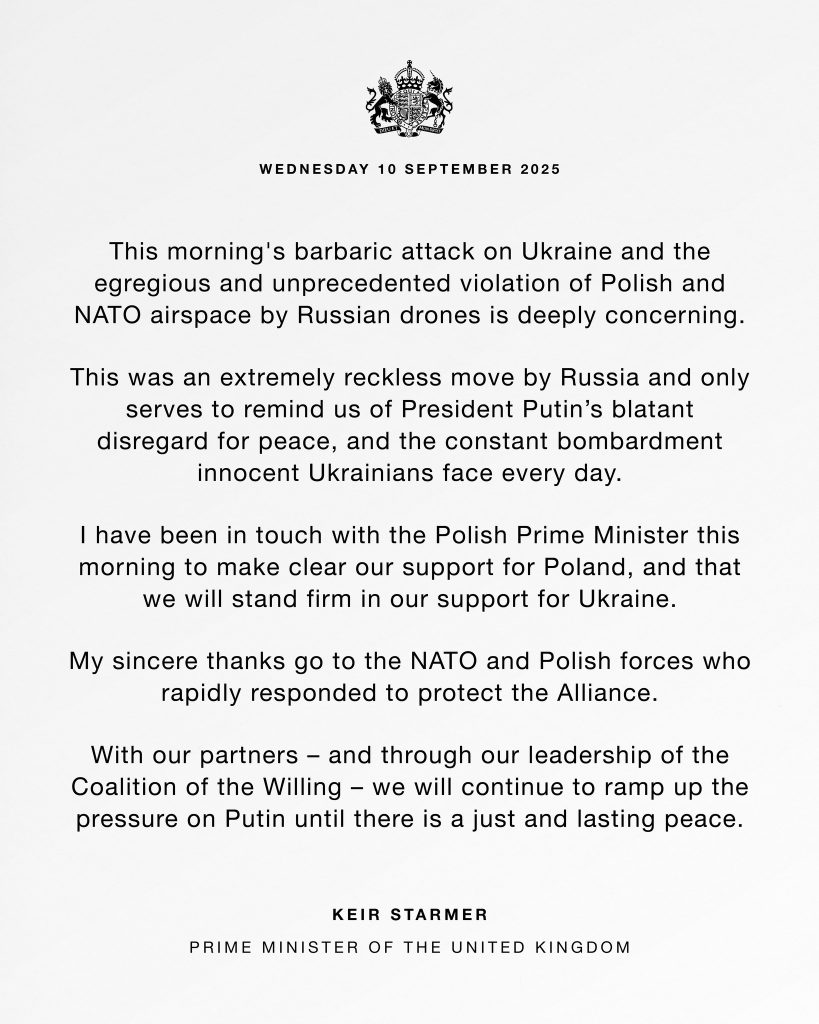


WHEN Poland invoked Article 4 of the North Atlantic Treaty this morning, it was not some dry procedural move. It was one of the rarest and most consequential actions in NATO’s history.
Article 4 is the alliance’s consultation clause. It has only been triggered eight times since 1949. For Warsaw to reach for it today—after Russian drones entered and were shot down over Polish airspace—signals just how serious this moment is.
Some will argue this is simply war spillover from Ukraine. But it is much more than that. For the first time in this conflict, a NATO member has used military force against Russian hardware. That is a red line crossed.
Prime Minister Donald Tusk has warned this could be the closest Poland has come to open conflict since World War II. He is right to see it as a deliberate provocation, not an accident of geography.
Putin’s dangerous bet
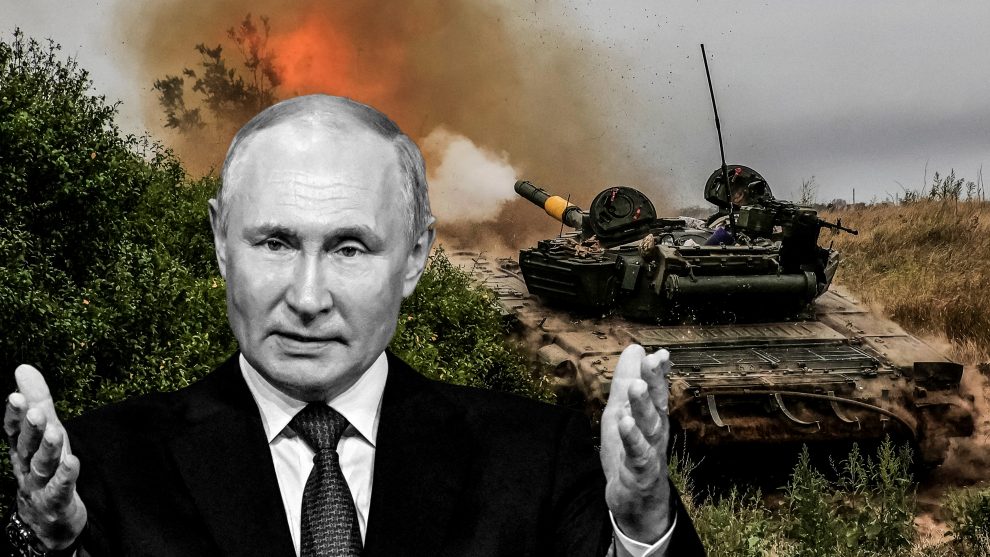
Vladimir Putin thrives on brinkmanship. He has always pushed just far enough to test Western resolve—Crimea in 2014, the full-scale invasion in 2022, now drones over Poland. Each time, the risk grows that he miscalculates.

His gamble is simple: NATO will be too cautious, too divided, too “pussy,” to borrow the blunt phrase heard on social media today, to do anything decisive. If that happens, he looks strong at home and abroad. To Russia’s citizens he becomes the leader who stood up to the West. To China, North Korea, and Iran he becomes proof that the Western alliance is timid.
The alliance cannot afford to look weak. NATO’s entire existence rests on credibility. If Article 5—the collective defence clause—comes to be seen as an empty promise, the alliance itself begins to unravel. And if NATO shrinks from defending Poland today, what signal does that send to Kyiv, to Taipei, or to Seoul?
That does not mean charging headlong into war. NATO does not want to stumble into a world war. But it does mean calibrated firmness: intercepting every incursion, reinforcing the eastern flank, and showing Moscow that deliberate provocations will carry costs.
The tightrope moment
We are now at one of those hinge points in history where deterrence and restraint must balance perfectly. Too little response, and Putin wins. Too much response, and the spiral could end in a global conflict.
That is why Article 4 matters. It forces NATO’s leaders into the same room, to share intelligence, to consider next steps, and to signal unity. What they decide in Brussels today will echo from Washington to Beijing.
The plain truth? The world is on a tightrope. And when geopolitics reaches this point, talk of torches, batteries and tinned food no longer sounds paranoid. It sounds like common sense.
Because if miscalculation wins out over restraint, it will not be diplomats or generals who pay the highest price—it will be ordinary people, from Milford Haven to Warsaw.
Explainer: Article 4 vs Article 5
- Article 4 – Consultation clause. Any NATO member can call urgent talks if it feels threatened. It does not automatically lead to military action, but it’s a clear warning signal.
- Article 5 – Collective defence. An armed attack against one ally is considered an attack against all. This clause was only triggered once—after the 9/11 attacks in 2001.